

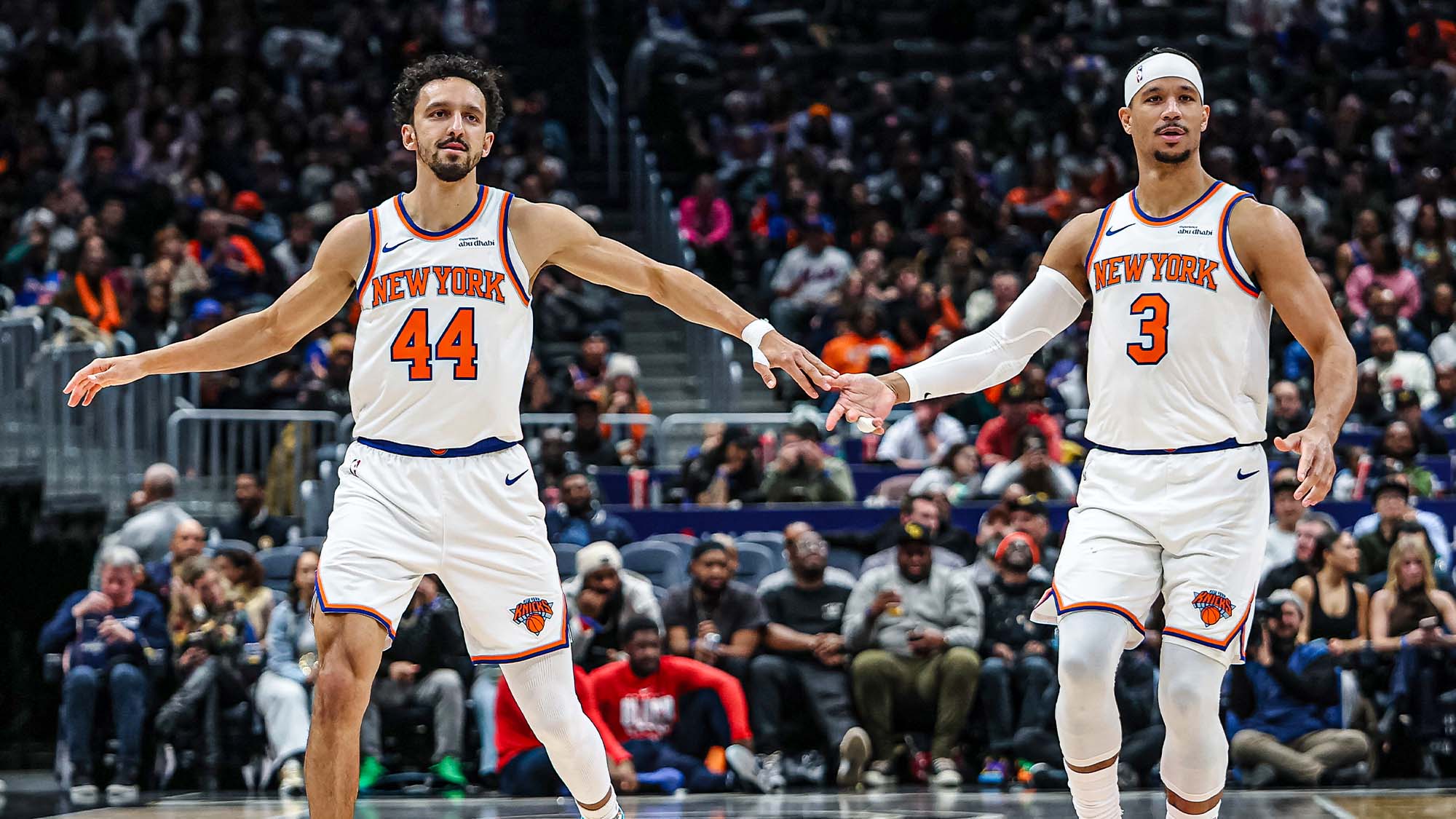
From October through April, many New York Knicks fans demanded a change to the team’s starting lineup whenever things went south.
It wasn’t a new topic. Throughout the 2024-25 season, especially in the playoffs, the Knicks’ starting five of Jalen Brunson, Mikal Bridges, Josh Hart, OG Anunoby, and Karl-Anthony Towns produced mediocre efficiency over an enormous sample size. That largely continued in 2025-26, amplifying the calls for New York to make a change.
But Mike Brown, like Tom Thibodeau before him, refused to budge. While Brown has been substantially more adaptable than Thibodeau in most aspects, he and his predecessor share an unwavering affinity for that five-man lineup.
And through 10 playoff games, Brown looked like a genius for standing pat. The Knicks’ starting five began to click, igniting New York to the most dominant 10-game start to a playoff run (in terms of point differential) in NBA history.
In a matter of one game, the calls for a lineup change are back—and this time, Brown might have no choice.
Game 1 comeback reveals Knicks’ formula
The Knicks were on the precipice of a disastrous Game 1 loss at Madison Square Garden.
From the start of the second quarter until midway through the fourth, New York appeared to have no answers for the Cleveland Cavaliers on either side of the floor. The Cavs got any shot they wanted on offense and forced the Knicks to take difficult shots on most of their possession.
Then… poof! The second-greatest fourth-quarter comeback in NBA playoff history.
What sparked it?
Going away from that wretched starting five, of course.
And it didn’t require a massive change. All the Knicks needed to do was make the one change that fans and analysts have called for: substitute Josh Hart for a willing shooter whom defenses have to respect.
With 9:09 remaining in the fourth quarter, Landry Shamet entered the game, forming a five-man group of himself, Brunson, Bridges, Anunoby, and Towns. From that point on, the Knicks outscored the Cavaliers by 25 points, with that same lineup on the court for nearly the entire 14:09 run (save for brief offense/defense substitutions).
Shamet finished the game with a team-high plus-minus of +25. Hart was a team-worst -23.
Stats can be wonky in one-game samples, especially when we’re talking about plus-minus. But a 48-point margin cannot be chalked up as a mere anomaly due to luck or randomness.
The eye test made it clear how much the Knicks benefited from swapping out Hart for a willing shooter. The offensive spacing was night-and-day based on that single change.
Cleveland employed a deliberate “ghosting” strategy on Hart, meaning they had Hart’s man essentially leave him unguarded on the three-point line. Hart, an unwilling shooter despite his solid percentage, played right into the Cavaliers’ hands. He rarely shot when open, and when he did, he shot poorly, finishing 1-of-5 from deep.
Hart will likely shoot better than that moving forward, but it doesn’t matter whether or not he makes the shots. Cleveland will continue to guard him that way because they know he will never shoot threes at a high volume, regardless of his percentage. As long as that continues, the Cavaliers will make life hell for the rest of the Knicks’ offense.
Cleveland’s starting five features two long, athletic, switchable bigs in Evan Mobley and Jarrett Allen. By placing one of these players on Hart and having them sag off, the Cavaliers have two elite rim protectors ready to help on a drive at all times. Whether that help comes from the weak side or the strong side, the combined length of Mobley and Allen is enough to squeeze any open space on the court when Hart’s man has the luxury to leave him completely uncovered.
That makes it nearly impossible for Brunson, Towns, and the rest of the Knicks’ primary scorers to have enough room to punish any potential mismatch they might get against James Harden, Donovan Mitchell, or anyone else. When the likes of Mobley or Allen are always lurking in the lane with their massive arms, the Knicks have little to no chance of creating any kind of advantage.
But once the Knicks replaced Hart with Shamet, everything changed. Shamet is not only a high-percentage shooter, but he will always let it fly when he’s open, so his man had to respect him off the ball. That took away the luxury of allowing Mobley and Allen to roam the floor.
It meant that the Knicks could go mismatch-hunting with Brunson. Finally, he could have one-on-one matchups against Harden without having to worry about an athletic shot blocker lurking.
The proof was in the pudding. New York’s drives yielded twice as many points per chance when Hart was off the court (1.259) versus when he was on (0.625).
That disparity is unsurprising when you consider that Hart’s average three-point attempt saw his closest defender standing an average of 9.1 feet away. Three yards of separation is great on a football field, but not on a court. When a wing player in your lineup is being treated that way, he makes it 4-on-5 for everyone else.
New York could get away with Hart’s hesitancy against Atlanta and Philadelphia because they didn’t have the defensive weapons that Cleveland does. Neither team had nearly enough size to suffocate the court to the same degree.
Additionally, the Hawks and 76ers were both strangely averse to attempting the ghosting strategy that Cleveland utilized so aggressively; Quin Snyder and Nick Nurse deserve flak for that. Kenny Atkinson, for all of his faults late in the game, made a wise strategic move to use that strategy against Hart, and it worked like a charm.
Once the Knicks forced Atkinson to play a different card, though, he had no answer. Cleveland continuously allowed Harden to get switched onto Brunson, and the Knicks spammed that matchup into oblivion. Without a non-shooter to disrespect, the Cavaliers didn’t have much of a choice but to let New York dictate the action.
The difference in the success of New York’s starting lineup with and without Hart was too drastic to be ignored by Mike Brown. This was no aberration; it was a loud-and-clear signal of what does and doesn’t work in this particular matchup against Cleveland. A 48-point swing is precisely what the Knicks needed to learn what their strategy should be in this series.
It shouldn’t be expected that Brown will suddenly bench Hart for Shamet or another shooter (Miles McBride being the other option). The starting lineup will stay the same in Game 2 and likely throughout the remainder of the playoffs. Whether that’s due to locker-room politics or sheer ignorance is up for debate, but we all know it’s true, so it isn’t worth spending time on.
What Brown can do is reduce his reliance on that particular five-man lineup throughout the game. He can go ahead and start it, for whatever reason, but it should not play too many minutes if it isn’t thriving.
If the Knicks get off to a slow start in the first or third quarters, Hart needs to come out for Shamet or McBride. The rope for the starting lineup should be very short, given how large a sample we have on their struggles over the past two seasons. They have not shown enough to deserve extended minutes to figure things out—not when a proven solution is sitting right there.
Give Brown credit for what he did in the fourth quarter of Game 1. He recognized what was happening and made a wise move to put Shamet in Hart’s spot with the starters. Once it started working, Brown stuck with it for the rest of the game. That was tremendous work on Brown’s part; a lot of coaches would have shoved Hart back in at some point instead of riding the momentum.
That, too, has to continue in Game 2. If similar issues play out for the starters over the first three quarters, Brown must go back to Shamet as the closer. If it’s McBride’s night instead of Shamet’s, he can put McBride in that role; McBride’s shooting would have a similar impact (although Shamet was also playing fantastic defense on Donovan Mitchell).
Cleveland’s double-big starting lineup is a major problem for New York’s starting five. That should be the main takeaway from Game 1 as the Knicks look to avoid having any more 40-minute stretches as poor as the one they had to begin this game.
But it doesn’t mean the Knicks are doomed. With one simple lineup change, they can suddenly give themselves a massive advantage over Cleveland’s starters.
Brown was gutsy enough to make that change for the final stretch of Game 1. Will he be bold enough to rely even more heavily on it in Game 2, using it to seize control of the game early rather than as a last resort?
The answer to that question could be what determines the rest of this series.