

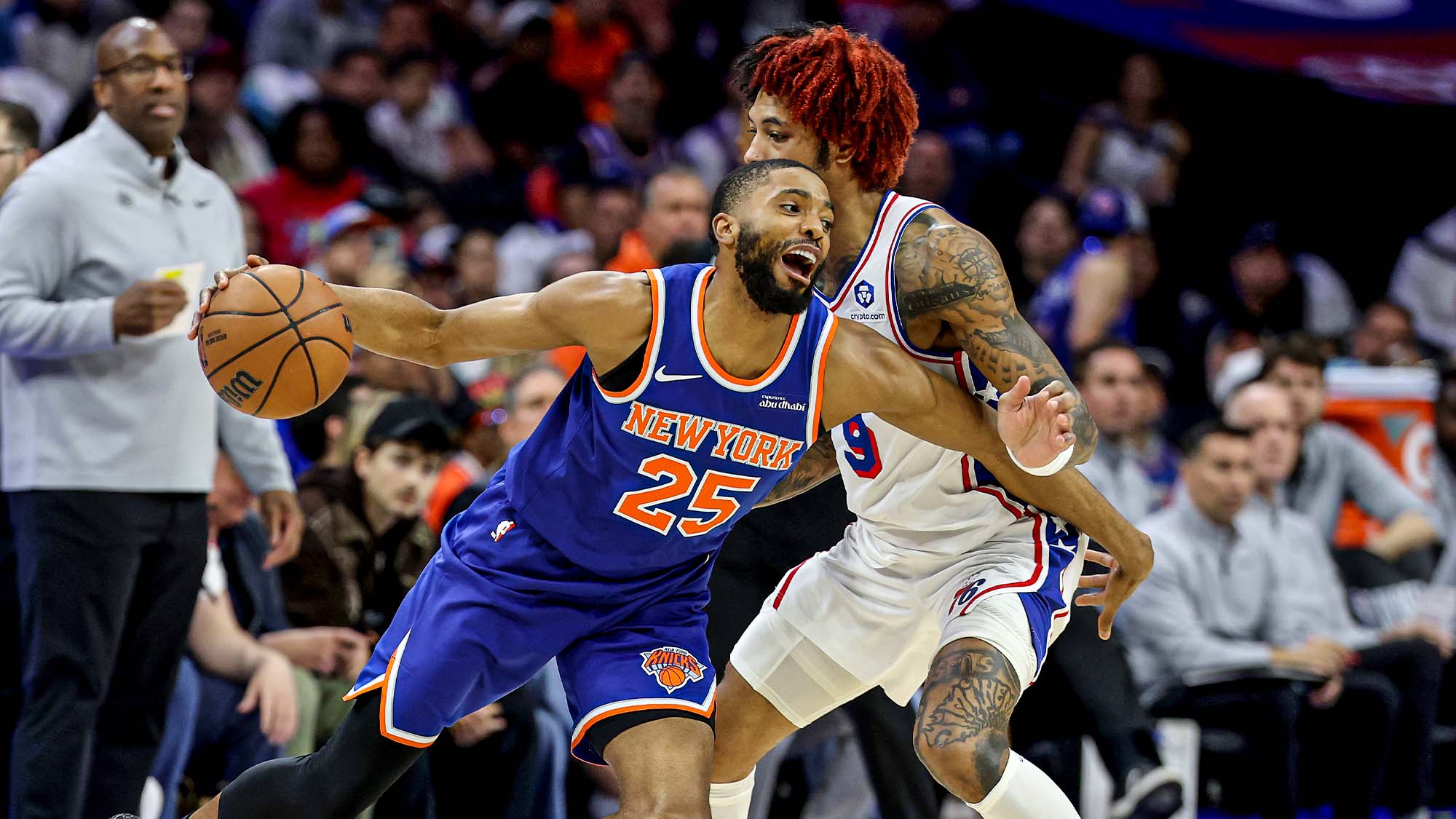
The New York Knicks are dominating the NBA playoffs to an unprecedented degree.
Through nine games of postseason basketball, New York not only has a 7-2 record with a 3-0 lead in the Eastern Conference Semifinals, but their +164 point differential is the best in NBA playoff history through nine games.
We knew the Knicks were a solid team. We knew they had title hopes.
Nobody expected them to look this unstoppable.
This is the same team that, back in January, lost by 17 points at home to the Dallas Mavericks to cap off a 2-9 stretch, prompting calls for their head coach to be fired. For that team to now be on the most lopsided nine-game run in postseason history, significant changes had to be made to their approach. That type of turnaround doesn’t happen because the team is simply on a hot streak.
Here are three ways the Knicks have altered their style of basketball to unlock the best version of themselves.
1. Greater emphasis on cutting (and using Karl-Anthony Towns to facilitate it)
At times in the regular season, it felt as if the Knicks were not generating as many easy buckets as they should for a team with that type of offensive talent.
That has changed in the playoffs.
By focusing more on running the offense through Karl-Anthony Towns in the high post, the Knicks are racking up significantly more easy baskets under the rim, especially off cuts.
In the regular season, New York ranked 23rd in the NBA with only 6.3 possessions per game that were finished by a cutter. In the playoffs, they have pumped that number up to 7.8, placing fourth among playoff teams.
Most importantly, those cuts have resulted in extremely efficient looks, as the Knicks are shooting 76.3% off cuts, third-best in the league.
Towns is largely responsible for this success. The following chart showcases how Towns’ passes tend to yield highly efficient shot attempts.
The Knicks have finally figured out how to properly leverage their offensive talent. Instead of my-turn-your-turn basketball, they are using the leverage of their top scorers to clear space for easy layups and dunks off back-door cuts.
2. Using Jalen Brunson off the ball
Jalen Brunson is a far more talented all-around offensive player than many give him credit for, and sometimes, that includes his own coaching staff.
Brunson can help the Knicks’ offense in more ways than just isolating and shooting jumpers off the dribble. He is an excellent shooter off the catch, knows how to make smart cuts, and offers superstar-level gravity to space the floor.
New York is finally maximizing these advantages.
Compared to the regular season, Brunson is setting more than twice as many off-ball screens per 100 possessions.
Brunson’s off-ball screening has created plenty of confusion for the defenses of both Atlanta and Philadelphia, leading to many of the cutting baskets that we discussed in the first section.
Brunson isn’t the first player you think of when you imagine the type of basketball player that you’d like to set a screen. But his size is irrelevant in those situations. It doesn’t matter how strong a screen he sets; the mere fact that the screen is being set by a man who averages 30 points per game in the playoffs since joining the Knicks means that all defenders involved in the action are focused on Brunson.
That allows other players to emerge from the traffic for a wide-open path to the rim.
3. Trusting Mikal Bridges to defend lead scoring guards on island
In back-to-back series, the Knicks have trusted Mikal Bridges to be the primary defender on the opposing team’s top scoring guard. They’ve left him on an island with gifted scorers who are much smaller and quicker than him, and trusted him to do the job with little to no help.
And he’s risen to the occasion.
In the first round against Atlanta, Bridges guarded the Hawks’ Nickeil Alexander-Walker on 53% of his defensive possessions, per Databallr. Across 158 possessions against Bridges, Alexander-Walker scored just 16 points on 53% effective shooting with 9 turnovers to 5 assists.
Lockdown.
Bridges’ 53% defensive possession rate against Alexander-Walker was the highest among the Knicks’ five starters against any individual Hawks player. It goes to show that New York trusted Bridges to handle Alexander-Walker essentially on his own. Bridges’ excellence in that role afforded New York the luxury to shade help toward areas where they needed it more.
Think Darrelle Revis in the 2009-10 New York Jets defense. When you can trust one man to shut down the opposing star on its own, it makes life so much easier for the rest of the defense.
Alexander-Walker scored 20.8 points per game in the regular season, so shutting him down was no small feat by Bridges. But a greater challenge awaited Bridges in the semifinals. And so far, he’s been even better.
Through three games against Philadelphia, Bridges has guarded Tyrese Maxey on a whopping 63.6% of his defensive possessions; once again, this is the highest rate by any Knicks starter against an individual Sixer.
On 78 possessions against Bridges, Maxey has scored 8 points on 44% effective shooting, with 7 turnovers to 3 assists.
Screw. Them. Picks.
The Knicks have the basketball version of “Revis Island” on their defense, and it’s changed everything for New York on that side of the basketball. If you are wondering why the Knicks have the NBA’s third-best defensive rating (103.5) in the playoffs, it all starts with Bridges.
Yet, it seems as if Bridges’ reputation among Knicks fans only spikes when he is hot offensively. Sure, it’s nice when he does his part on that end, but even when he has been absent offensively, he has been playing downright dominant basketball on the other end.
Letting Bridges be their shutdown man-to-man corner against the opponent’s speediest weapon has been a tremendous adjustment by New York in these playoffs. It was a gamble, to be sure; if Bridges struggled in the role, the entire scheme would collapse. But the potential reward was worth the risk, and we’re seeing those rewards in full force on a nightly basis.