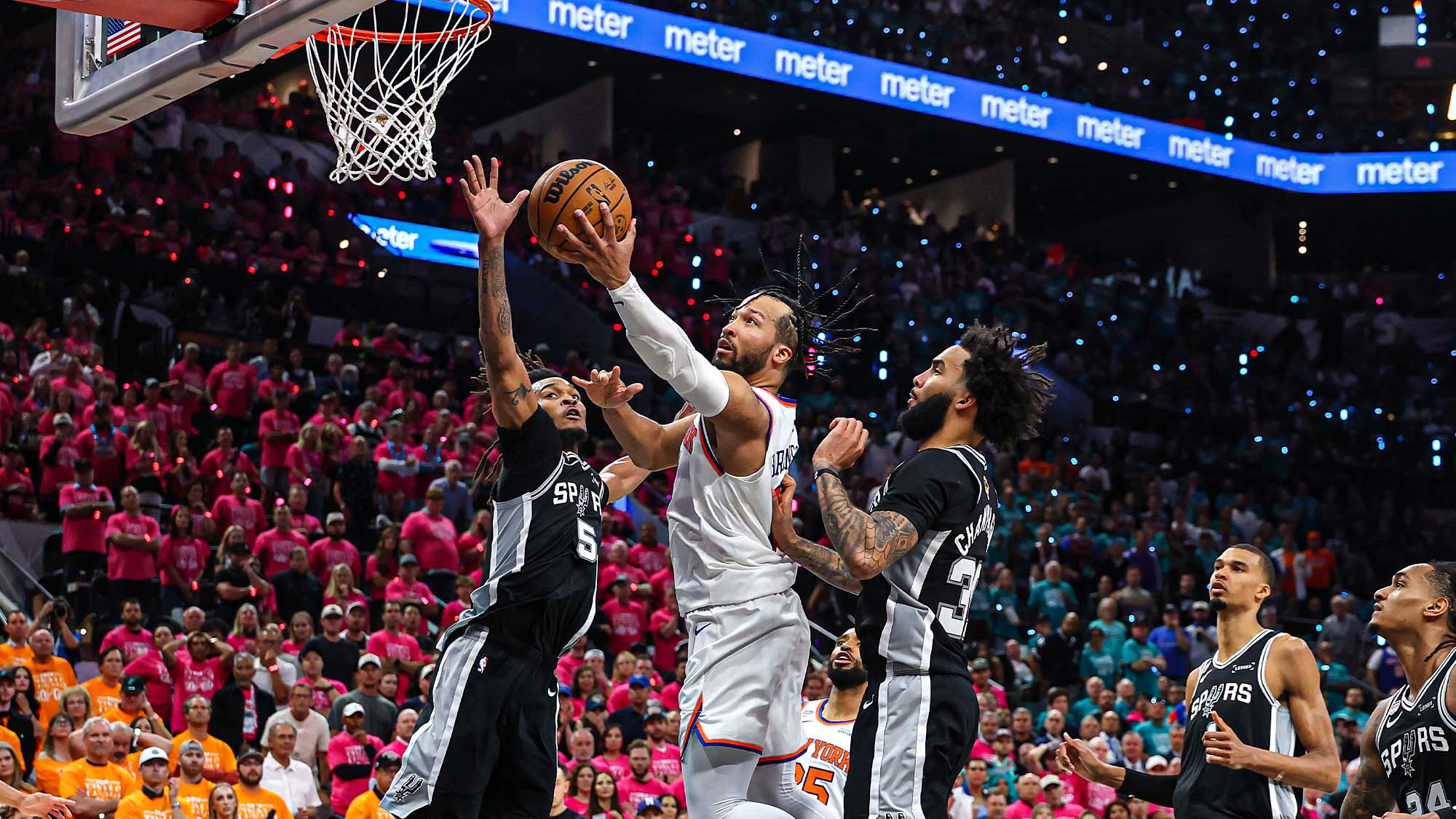
If there’s one reason for the San Antonio Spurs to be very, very afraid, it’s this:
The New York Knicks didn’t play their best in Game 1, and they still pulled off a 10-point road win.
New York can perform better in a myriad of areas after a gritty comeback victory to open the 2026 NBA Finals. Here are three specific categories in which the Knicks should strive to improve in Game 2 as they seek a commanding 2-0 lead headed back to Madison Square Garden.
1. Get Jalen Brunson’s shot attempts down
Jalen Brunson’s clutch heroics were astounding in Game 1; there’s no doubt about that.
But if the Knicks want to seal the victory in Game 2 before needing to rely on Brunson’s heroics, they must be more efficient offensively throughout all four quarters. The Knicks’ 105 points in Game 1 were their fewest of the playoffs so far; it’s the defense that won New York this game.
There were certainly stretches in Game 1 where the Knicks’ offense became too Brunson-centric, with many possessions culminating in low-percentage attempts for The Captain. Brunson finished the game with 31 field goal attempts, tied for his most of the season (including the regular season).
Brunson made just 12 of those 31 attempts (38.7%), including 2-of-9 threes (22.2%) and a measly 4 attempts from the line (all makes). When 33 true shot attempts yield 30 points, it’s inefficient offense. Brunson’s true shooting percentage was 45.8%.
Of course, Brunson is due to shoot better than that moving forward. But the ceiling of the Knicks’ offense will be much higher if Brunson is taking fewer shots for a higher percentage than vice versa.
In Game 2, the Knicks must find a way to turn some of Brunson’s low-percentage shots into more efficient looks for his teammates. New York’s offense will fare much better if Brunson scores 25 points on 19 field goal attempts instead of 30 points on 31 field goal attempts. There were some unnecessary early-shot-clock attempts in Game 1 that can be converted into better shots for someone else on the court in Game 2.
In the playoffs, when Brunson shoots more than 20 field goal attempts, the Knicks are 6-2 with an average of 111.1 points per game. But when he shoots under 20 field goal attempts, they are 8-0, with their scoring average skyrocketing to 127.9 points per game.
2. Winning the transition battle
The Knicks were phenomenal in one of our three keys for Game 1: the turnover battle. They turned the ball over just 8 times to San Antonio’s 13. It helped them rack up 5 more field goal attempts than the Spurs (although San Antonio took 7 more free throws) despite losing the rebounding battle 54-49.
In addition to winning the overall turnover battle, the Knicks won the battle of live-ball turnovers. They had 8 steals to the Spurs’ 4.
Having a sizable advantage in turnovers and steals should set a team up to dominate the fastbreak game. However, despite the Knicks’ success in the turnover and steal columns, it was the Spurs who fared better in the open court. San Antonio won the battle in fastbreak points, 15-12.
The Knicks are due to fare much better at translating their steals to points. In the playoffs, they lead the NBA with 1.28 points per possession in transition. They are so far ahead of the rest of the league in this category that the gap between them and the second-ranked Celtics (1.28 to 1.19) is equal to the gap between the Celtics and the eighth-ranked Pistons (1.19 to 1.10).
The challenge, though, is that San Antonio excels at defending in transition. The Spurs are allowing a league-low 0.98 points per possession in transition during the playoffs.
However, the Knicks are second-best in transition defense (1.03), while the Spurs’ transition offense ranks just seventh out of 16 teams in the playoffs (1.12 points per possession). Combining offensive and defensive performance, the Knicks are a net +0.25 in points per transition possession during the playoffs (1.28 to 1.03), while the Spurs are well behind at +0.14 (1.12 to 0.98).
If the Knicks can replicate their success at both avoiding and generating live-ball turnovers, look for them to translate it to a much bigger advantage in fastbreak points.
Karl-Anthony Towns deserves immense credit for his defensive performance in Game 1, arguably making him the MVP of the game. While Towns did not have any steals of his own, his defensive intensity against Victor Wembanyama helped to force the young superstar into 6 turnovers.
New York trusted Towns to hold up on an island against Wemby, while encouraging their wings to reach in and poke at the ball when he put it on the floor. This strategy contributed to 4 steals for Josh Hart and 2 for Mikal Bridges.
Although these steals didn’t create many easy buckets on the other end in Game 1, the Knicks must keep up the defensive pressure in Game 2 and trust that it will be more conducive to their offensive success.
3. Rebounding (particularly defensively)
The Knicks won Game 1 despite falling short on the glass. The Spurs had a 54-49 rebounding edge, including 14-10 on the offensive glass.
This is an area where the Knicks should be expected to have an advantage. According to NBA.com, in the playoffs, New York ranks third in offensive rebounding percentage (33.5%), while San Antonio ranks 12th (30.7%). Defensively, the Knicks are third-best (73.4%), while the Spurs are fourth, but by a sizable gap (69.0%).
The Knicks’ net offensive rebounding percentage in the playoffs is 6.9%. San Antonio’s is -0.3%.
That is a wide enough disparity for Knicks fans to feel confident that the rebounding battle should shift in New York’s favor moving forward. It’s all the more reason for Spurs fans to be deathly afraid of the fact that San Antonio blew Game 1.
A few different Knicks players should be expected to step up here. Most notably, Mitchell Robinson had just 1 offensive rebound in 13 minutes. The hope is that Robinson was still getting acclimated to playing through a surgically repaired finger with a brace on his hand, but if Robinson is limited throughout the series, it could reduce New York’s potential to win the rebounding battle.
The good news is that Robinson still collected 5 defensive rebounds in his 13 minutes, giving him 6 total boards in limited action. But it is much tougher to go up and grab a tough contested rebound on offense than to swallow an uncontested defensive board. To maximize their potential rebounding edge, New York needs Robinson to be at least somewhere close to his peak strength on the offensive glass.
New York can also expect more offensive boards from Josh Hart, who had just 2, although he was a demon on the defensive glass, collecting 13 boards.
OG Anunoby and Mikal Bridges combined for just 4 defensive rebounds, less than half their combined playoff average of 8.1. They contributed to allowing three of the Spurs’ starting non-bigs, Julian Champagnie, Devin Vassell, and Stephon Castle, to combine for 10 offensive rebounds. Most likely, we won’t see this type of performance again from that trio; they are averaging a combined 3.4 offensive rebounds per game in the playoffs.
Given how many outlier performances there were on the glass in Game 1, it is unlikely that the Knicks will be outrebounded in every game of the series. Considering they have already proven they can win a road game by 10 without winning the rebounding battle, the Knicks’ outlook moving forward is auspicious.