
Estimated reading time: 4 minutes
The New York Knicks made short work of the Philadelphia 76ers in the Eastern Conference Semifinals, leaving the orange-and-blue faithful feeling endlessly optimistic going into the Eastern Conference Finals.
Part of that confidence stems from the dominant nature of New York’s four-game sweep. The Knicks won the four games by an average of 22.3 points, with each victory coming by at least six points and two of the four coming by 30+ points.
But it isn’t just the Knicks’ lopsided point differential that has fans believing New York has a high chance of winning the Eastern Conference Finals. There are also the benefits that come with the Knicks winning the series as quickly as possible.
The Knicks eliminated the 76ers less than six full days after the tip-off of Game 1. Meanwhile, as we sit here two days after New York’s series-clinching victory, the Detroit Pistons and Cleveland Cavaliers are still knotted up at 2-2.
The earliest Detroit and Cleveland’s series could wrap up is May 15, five days after the conclusion of the Knicks’ series. If it goes to seven games, which is feeling like a strong possibility, the series will end on May 17, a full week after the Knicks swept Philly.
This substantial rest advantage feels like a major positive for a veteran Knicks team. That would be the case no matter what, but it is especially critical due to the recent hamstring injury suffered by OG Anunoby.
New York was able to confidently rest Anunoby over the final two games without forcing him back into the lineup. Now that they’ve completed the sweep, Anunoby will have at least 11 days to rest from the point of his May 6 injury.
All signs point to the Knicks’ rest differential being a tremendous advantage going into the Eastern Conference Finals.
But what does history say? Do teams that advance through the semifinals in fewer games have an advantage in the conference finals?
Let’s find out.
Does rest matter going into the conference finals?
Yes, in fact, it does—quite a bit, actually.
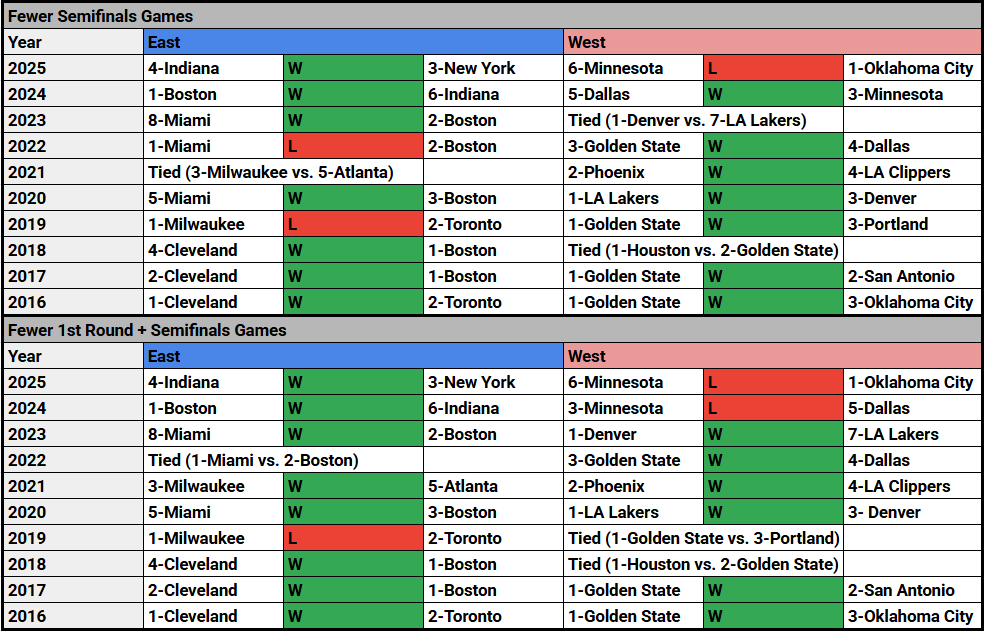
Over the last 10 playoff tournaments (2016-25), 17 of the 20 conference finals series featured one team that played fewer semifinal games than the other.
Of those 17 series, 14 were won by the team that played fewer games in the semifinals.
Yep, you read that right: Since 2016, conference-final teams that played fewer semifinal games than their opponent had a 14-3 (.824) series record.
The only teams to lose were the 2025 Minnesota Timberwolves (vs. Oklahoma City), the 2022 Miami Heat (vs. Boston), and the 2019 Milwaukee Bucks (vs. Toronto).
It is worth noting, too, that the Knicks also played fewer first-round games than whichever opponent they will face in the next round. New York needed six games to defeat Atlanta, while both Detroit and Cleveland went to seven games.
If we account for total games played between the first and second rounds prior to the conference finals, the final result is the same. Of the 20 conference-final series over the last 10 years, 17 had a team with a rest advantage across the first two rounds, and 14 of those teams advanced.
Two of those three losers are the same: the 2025 Timberwolves and the 2019 Bucks. However, instead of the 2022 Heat (who were actually tied with the Celtics in terms of total games between the first two rounds), the 2024 Timberwolves (vs. Dallas) are the other team to blow a two-round rest advantage.
If we isolate teams that played both fewer games in the semifinals and across the first two rounds combined, the record is 12-2, with the 2025 Timberwolves and 2019 Bucks being the only losers.
So, yes, Knicks fans, the swiftness of your team’s playoff advancement relative to their rivals is absolutely a legitimate reason to be optimistic about their chances of reaching the NBA Finals.