Months of hype about a presumptuous New York Knicks-Boston Celtics rematch in the Eastern Conference Semifinals were all for naught.
The Knicks, of course, are right where they planned to be. It’s the Celtics who failed to handle business.
Instead, the Knicks will clash with the seventh-seeded Philadelphia 76ers, fresh off a shocking seven-game series victory over Boston.
New York is heavily favored to win the series, but Philadelphia cannot be taken lightly. The 76ers’ seventh-seeded placement was largely due to injuries. Now, Philly is healthy, and they showed in the first round what they are capable of when that is the case.
For the Knicks to ensure they live up to expectations as the team with homecourt advantage in the second round, they must nail down these five keys against Philadelphia.
1. Stay disciplined against Joel Embiid
Joel Embiid is the NBA’s all-time leader in made free throws per game (8.3). Even in an injury-ravaged year at age 31, Embiid made 7.5 free throws per game in the regular season and 7.8 per game in the first round.
The 76ers rely heavily on Embiid’s scoring to win games, and Embiid relies heavily on free throws to get his points. Thus, we are left with a simple goal for New York: keep Embiid off the foul line.
In the regular season, Philadelphia went 13-5 (.722) when Embiid shot at least nine free throws, compared to 11-9 (.550) when he shot fewer than nine. If Embiid reached 13 free throws, Philly went 5-1.
Across his four games in the first round, Embiid attempted nine free throws in three games, and the 76ers won two of those.
Keeping Embiid off the line needs to be a top priority for the Knicks defenders who are slated to match up with him often. They need to play with the mentality of staying disciplined and forcing him to shoot over them.
It’s an approach that is far easier said than done, but if the Knicks adhere to it, the results should be positive. At this stage of his career, Embiid isn’t converting shots from the field as effectively as he used to.
Across the last two seasons (57 games)—his first two post-30-years-old campaigns—Embiid has an effective field goal percentage of 51.3%, well below his 55.3% mark from the previous four seasons.
In particular, Embiid’s finishing around the rim has greatly declined. Since the start of his age-30 season, Embiid has made just 66.4% of his shots from within three feet, compared to 77.0% over the previous four seasons.
If the Knicks stay on their feet and force Embiid to shoot jump hooks, contested layups, or fadeaway jumpers, Embiid will likely not score at a superstar-caliber level of efficiency. He can still score at that clip if the Knicks jump for joy at every pump fake, though.
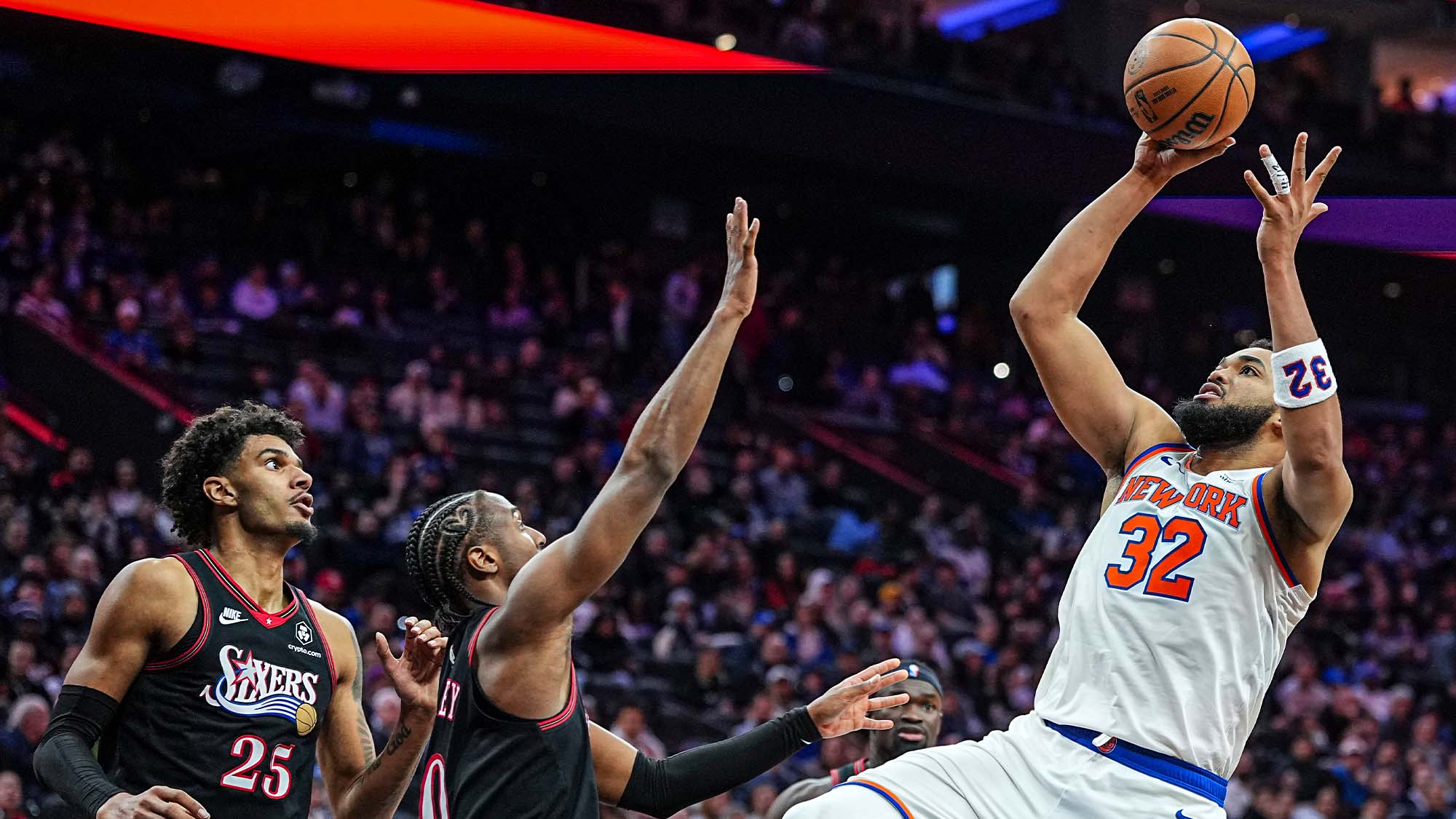
There’s another major reason this category is critical for New York: Keeping Karl-Anthony Towns on the court.
Towns was indispensable for New York in their first-round series against Atlanta, as the Knicks outscored the Hawks by 21.8 points per 100 possessions when he was on the court. Many of New York’s worst stretches in the series came with Towns on the bench.
If Embiid gets Towns in early foul trouble, the Knicks will have to survive longer stretches without Towns than they would like.
Again, it is far easier for me to sit here and type this than it is to actually do it under NBA Playoff pressure against a 280-pound future Hall-of-Famer, but Towns and Mitchell Robinson must stay grounded against Embiid.
The coaching staff’s message to them should be as follows: Use your vertical length to contest every shot by going straight up without attempting a block or steal, and trust that it will work out in the long run, even if it results in a few layups that could have been blocked. An Embiid field goal attempt will always be less efficient than an Embiid trip to the foul line.
2. Take the ball away
One of the anchors of Philadelphia’s first-round upset was their ball security. They averaged just 10.7 turnovers per game in the series.
Going back to the regular season, the 76ers’ ball security has been a critical part of their offense. They ranked fifth-best in the NBA with 13.6 turnovers per game.
Philly relies heavily on ball security to win games. In the regular season, when they had 10 turnovers or fewer, the 76ers went 15-4. If they had 17 turnovers or more, they went 2-15.
In the first round, the 76ers went 3-1 with 10 turnovers or fewer, and 1-2 otherwise.
The reason Philadelphia’s turnover number is so critical to their success is that they struggle to out-shoot opponents from the floor. In the regular season, their 53.0% effective field goal percentage ranked 26th in the NBA, and they were even worse in the first round, shooting 51.4% over the seven games to Boston’s 52.3%.
Thus, the 76ers rely on the possession battle to be successful. If the possessions are equal, Philadelphia probably won’t have enough firepower to come up positive on the scoreboard. But if they can buy some extra possessions over the course of the game through their ball security, they can come out on top.
The Knicks must prioritize finding ways to facilitate turnovers on defense. It’s something they did well in the back half of their series against Atlanta. In their Game 4 and Game 6 wins, the Knicks forced 19 turnovers apiece.
Five different Knicks players averaged at least one steal per game against the Hawks: OG Anunoby (1.8), Karl-Anthony Towns (1.7), Josh Hart (1.3), Jalen Brunson (1.0), and Jose Alvarado (1.0). New York needs this type of defensive aggression to continue against Philadelphia. Keep the 76ers’ shot attempts down, and they likely won’t shoot at a high enough clip to win four games.
3. Put Josh Hart on Tyrese Maxey, Mikal Bridges on Paul George, and OG Anunoby on Kelly Oubre Jr.
When the Knicks needed a C.J. McCollum stopper, Josh Hart stepped up to the plate.
New York needs another heroic defensive effort from Hart in the semifinals, this time against a far tougher matchup.
Tyrese Maxey has developed into a playoff megastar for the 76ers. He averaged 29.8 points per game in their 2024 series against the Knicks, and in his next playoff series two years later, he averaged 26.9 points to defeat the Celtics, shooting 41.8% from three and 96.2% from the line. Toss in his 6.6 assists per game to 1.3 turnovers, and Maxey was an absolute dynamo against Boston.
The Knicks have a few different options to defend Maxey, but Hart makes the most sense to start out. He has the height to prevent Maxey from shooting over him, and the size to avoid getting bumped off his spot on drives to the rim. Maxey’s quickness will be an issue for any Knicks defender, but Hart has enough agility to at least keep Maxey in front of him and force jumpers.
Hart has a strong defensive track record against Maxey, albeit in a small sample size. On 71 possessions against Hart over the last three seasons, Maxey has a true shooting percentage of just 33.9%, while averaging a measly 3.2 assists per 75 possessions.
Mikal Bridges has also done a great job on Maxey since 2024, and it’s over a larger sample size. On 221 possessions against Bridges, Maxey has a 49.6% true shooting percentage with 4.1 assists per 75 possessions.
Bridges gives New York a fantastic fallback plan if Hart doesn’t work out. To start, though, the Knicks have a higher defensive ceiling with Hart on Maxey and Bridges on Paul George.
Since 2024, on 89 possessions against Bridges, George has a 41.7% true shooting percentage. He scored 12.7 points per 75 possessions and generated zero free throw attempts. Hart, over the same span, has allowed George to score 21.3 points per 75 possessions on a 50.5% true shooting percentage, which is still good, but not close to Bridges’ success.
So, where does this leave the Knicks’ best defender, OG Anunoby?
Kelly Oubre Jr., of course.
I know what you’re thinking: Why stash New York’s defensive demon on the fifth-leading scorer in Philly’s starting lineup?
Well, the appeal of placing Anunoby on Oubre is that Oubre’s lack of shooting would yield Anunoby the opportunity to be aggressive as a helper off the ball.
While Oubre shot a career-best 36.0% from three in the regular season, he is a career 32.7% shooter. In the first round, Oubre shot 4 for 25 (16.0%) from downtown.
Oubre also isn’t a willing three-point shooter, especially in the playoffs; in 13 playoff games with the 76ers, he has shot just 3.8 threes per 36 minutes, barely above Josh Hart’s playoff-career 3.5 average with the Knicks.
With Anunoby on Oubre, the Knicks can give him the freedom to aggressively sag off and provide help. He can also be encouraged to jump passing lanes in pursuit of steals; remember, forcing turnovers is critical against Philadelphia. Anunoby is the Knicks’ top producer of steals, and he will get his best chance to stockpile them if he guards someone that he doesn’t have to cling to off the ball.
Unlike against Atlanta (Dyson Daniels), there won’t be a great hiding spot for Jalen Brunson against Philadelphia. The Knicks’ best bet might be to put him on VJ Edgecombe and gamble that the rookie will go cold if pressured into isolation situations in a second-round playoff series; Edgecombe shot just 30.6% from deep in the first round.
Towns, of course, will be tasked with guarding Embiid, and the key is staying out of foul trouble. But with Anunoby having some freedom to roam, Towns can expect help. Forcing Embiid to kick out to Oubre for threes is a gamble New York will gladly live with.
Here are your ideal Knicks-76ers matchups to start out:
- Josh Hart on Tyrese Maxey
- Mikal Bridges on Paul George
- OG Anunoby on Kelly Oubre Jr.
- Jalen Brunson on VJ Edgecombe
- Karl-Anthony Towns on Joel Embiid
As the series goes along, these matchups should be expected to change. The NBA playoffs are defined by game-to-game adjustments. If something isn’t working, it’s up to Mike Brown to quickly conjure a solution.
The Knicks may not even agree with these matchups to start out. But the data is there to support it as the highest-percentage bet. At the very least, Brown would be wise to consider moving to these matchups at some point in the series if his initial plan does not pan out.
4. Tread water with starters, dominate bench minutes
With 10 starters on the court, these two teams should be fairly even. That is especially true when considering how infamously mediocre New York has been with the five-man combination of Brunson, Bridges, Hart, Anunoby, and Towns.
Where the Knicks can really separate themselves in this series is with their depth. Philadelphia’s subs are nowhere near as effective as New York’s.
Outside of sixth-man Quentin Grimes, the 76ers’ backups were largely unplayable against Boston. Philadelphia was outscored by 11.8 points per 100 possessions across 107 minutes with their seventh man, backup center Andre Drummond, on the court. When their eighth man, Justin Edwards, was on the court, the 76ers were outscored by an unfathomable 34.1 points per 100 possessions.
Compare this to the Knicks, who often play some of their best basketball when one of their reserves is in the game.
In the first round, it was New York’s bench minutes that tilted the tide. Their top three players in plus-minus per 100 possessions were Jose Alvarado (+36.1), Jordan Clarkson (+29.0), and Miles McBride (+25.9).
Even if you go back to the regular season, their top two players in this category were Alvarado (+12.7) and McBride (+10.6). Mitchell Robinson (+8.7) fared better than every starter besides OG Anunoby (+9.0).
The Knicks’ formula is to tread water with the starters on the court and open up an advantage when the bench comes in. Philly and New York will be evenly matched to open the first and third quarters and to close the fourth, but otherwise, the Knicks should have a major advantage. If the Knicks can stay around a net-zero in the starters-versus-starters minutes, they should be in great shape.
5. Play low-variance basketball
The Celtics are a better team than the 76ers.
Boston lost because they stubbornly adhered to their high-risk, high-reward style of basketball, which yielded an opening for Philadelphia to close the talent gap.
Across their four losses in the series, the Celtics shot 49 for 179 on threes. No, that is not a typo. They launched 44.8 threes per game and made 27.3% of them. That’s 32.5 bricks per game.
If you rely on the lowest-percentage shot type at such a massive volume, you leave yourself susceptible to long stretches of ice-cold shooting, cracking the door open for a less talented team to seize the advantage.
This was never more apparent than at the tail end of Game 7.
The 76ers opened the fourth quarter with a 13-point lead. Boston proceeded to go on a 23-11 run to cut the lead to 1 with under four minutes left. During that run, just 6 of their 23 points came via the three.
Yet, after they cut the lead to 99-98, the Celtics went on a stretch in which they shot threes on 6 out of their next 8 shots, missing all of them. Philly turned half of the missed threes into baskets on the other end, and that was all she wrote.
The Knicks must avoid falling into the trap that doomed Boston; the same trap that, in fact, allowed New York to take down Boston last year. The Celtics’ playoff-record 45 missed threes in Game 1 of the 2025 Semifinals will forever live in infamy.
As appealing as it is to chuck up a high volume of open threes when you are the better team and can easily manufacture them, it is critical to realize that threes are a high-variance style of offense, which increases the risk that you, as the favored team, cede your advantage. No matter how open the threes are and how good the players shooting them are, any team can go ice-cold from three in any given game, or any given stretch of games.
No team will go ice-cold on wide-open layups and dunks.
The Knicks are strongly favored in this series. They were a better team than Philadelphia in the regular season, played better in the first round, and have a better roster on paper. While the teams split their regular season series, the Knicks outscored them across those games by 8.0 points per game.
If New York wants to optimize their advantage in this series, they should prioritize playing low-variance basketball. That means relying less on threes and more on twos.
This style would mean the climb to building a sizable lead would be slower, but in the end, it will offer a higher chance of yielding victories than a heavy reliance on threes. The Knicks need to get the highest-percentage shot each time down the court, not the highest point-per-possession shot.
Keep generating efficient looks from inside the arc each time down, and the Knicks will eventually pull away more often than not.
Rely too heavily on threes, and the Knicks will leave themselves vulnerable to the ice-cold shooting stretches that erase any talent advantage they have. You can use your talent advantage to create open threes all day, but if they don’t go down, it means nothing. On the other hand, generating open layups and dunks will (almost) always result in a reward. Generating the layup/dunk is the entire battle; there is little to no finishing aspect to create variance, as there is with threes.
The great news is that New York already seems to understand this. As their first-round series against Atlanta progressed, the Knicks started to realize that they were the better team and could create automatic buckets inside the arc nearly every time down. Their reliance on threes decreased, and with it, their offensive efficiency increased.
In their Game 2 loss, the Knicks shot 3 for 11 from downtown in their 15-point fourth quarter, contributing to an epic collapse. While leading for the entire quarter, they shot many threes to end late-game possessions where a simple two-pointer or free throw would have been enough to ice the win.
In their Game 3 loss, they opened the game shooting 4 for 19 from three in the first half, contributing to an eight-point halftime deficit (just 50 points scored) that was too big to erase despite a stronger second half.
From there, the Knicks altered their focus to higher-percentage looks. Across their Game 4 and Game 5 wins, the Knicks averaged just 28.5 three-point attempts per game.
Game 5 was particularly notable, as New York shot just eight threes in the entire first half, helping them go up 58-44 at the break. In Game 6, the Knicks shot just 16 threes in the first half compared to 43 total field goal attempts and 22 free throws.
Don’t be the Celtics. Realize you’re the better team and maximize it.