
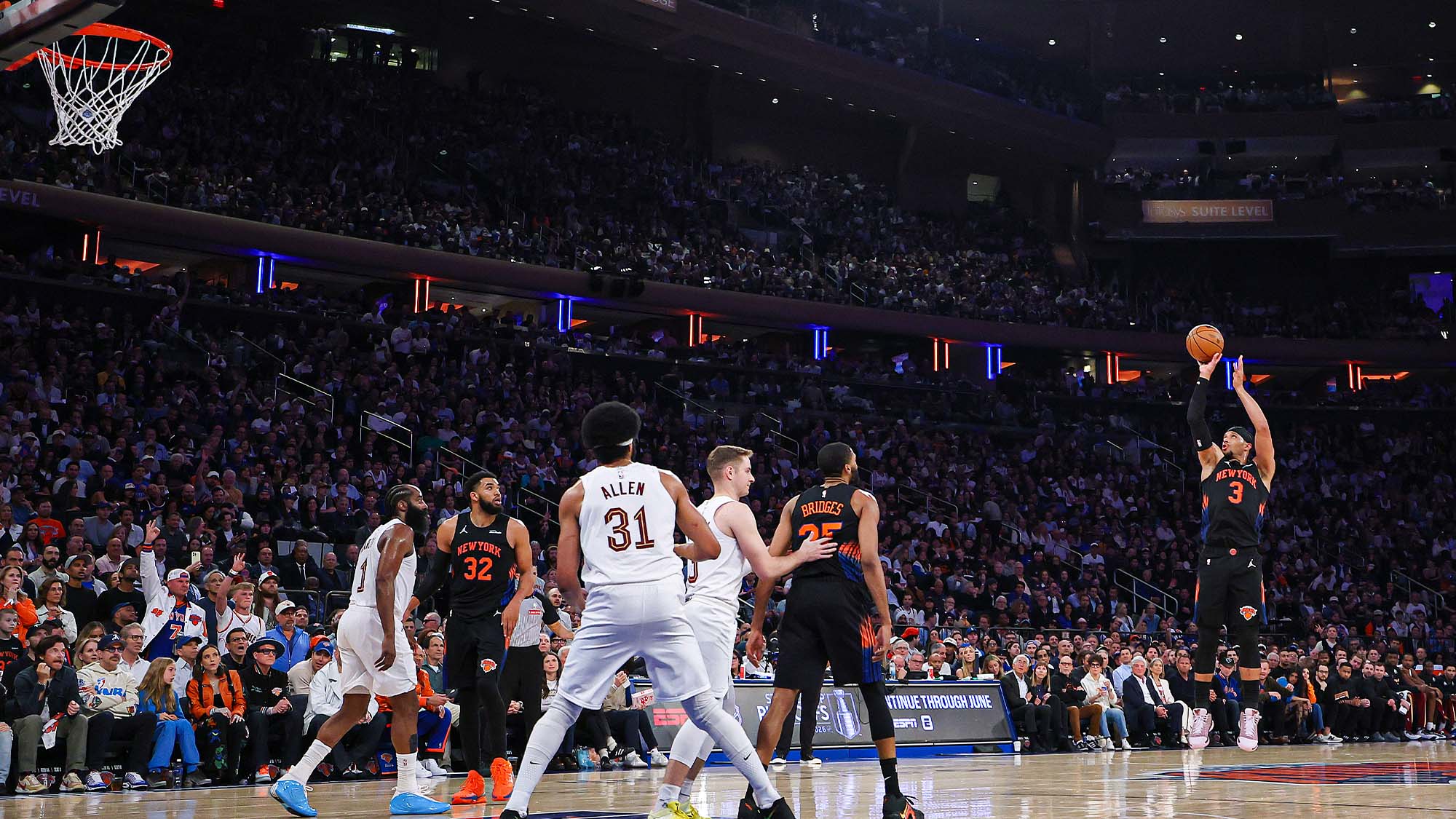
Following the New York Knicks’ Game 1 victory in the Eastern Conference Finals, we discussed the possibility of New York reducing Josh Hart’s role in favor of shooters like Landry Shamet and Miles McBride.
It was a reasonable conversation to have. After all, Hart was a game-low -23 in Game 1, while Shamet was a team-high +25. That 48-point disparity was primarily comprised of the Knicks’ 44-11 game-ending run. For the majority of that stretch, Shamet assumed Hart’s role alongside the Knicks’ four other starters.
In Game 1, it seemed untenable to continue playing Hart with the rest of the Knicks’ starters against Cleveland’s starting five, due to the Cavaliers’ double-dig duo of Jarrett Allen and Evan Mobley.
Both are elite defenders, possessing unique combinations of length, size, and athleticism. The Cavs would place one of them on Hart and have them sag off to clog the paint or impede driving lanes, a strategy often dubbed “ghosting”. They dared Hart to shoot, betting he wouldn’t beat them with his jumper, while committing all resources to making life hell for Jalen Brunson and Karl-Anthony Towns.
For 40 minutes, it worked. Then, the Knicks put a shooter in Hart’s shoes, defeating Cleveland’s ghosting strategy and instantaneously sparking a run of unstoppable offensive play for New York. Most of the points came via Brunson’s ability to go one-on-one since there was no longer a Knicks player Cleveland could leave open to double Brunson.
Given everything that happened, it seemed like a no-brainer to swap Hart out of the starting lineup for a shooter in Game 2. We all knew a starting-lineup change would not happen, of course, so the reasonable solution was either to reduce Hart’s minutes or to at least have a quick rope if he continued to enable Cleveland’s ghosting strategy.
Neither happened. Hart started and played 33 minutes, including the majority of the fourth quarter.
And the Knicks won by 16 in regulation.
That’s because when Hart realizes that he is allowed to shoot threes, the Knicks become nearly unbeatable.
A few Hart threes are all it takes to make New York an unsolvable puzzle
In Game 2, Hart scored 26 points on 5-of-11 shooting from downtown. After an ugly first quarter-and-a-half in the “What did Hart do when he was left wide-open?” department, he finally started to shoot with confidence when he received wide-open catches behind the line. That unlocked everything for New York.
In the regular season, the Knicks were 13-2 with an average point differential of +12.6 when Hart made at least three triples. So far in the playoffs, they are 2-0 with a +23.0 point differential when that happens.
Between the regular season and the playoffs, New York is 15-2 (.882) with a +13.8 point differential when Hart makes at least three triples. It’s a level of play on par with the 1995-96 Chicago Bulls’ historic regular season (.878, +12.2).
That is how dominant the Knicks are when Hart becomes a shooter—something we have all seen that he can be when he plays with confidence on the offensive end.
The impact of Hart’s shooting is not just about the points that Hart scores off of his own threes. Even more important is the way that a confident Hart leaves the defense without any answers to stop New York’s talented offense. Once Hart establishes that he is a shooting threat, the rest of his already-dangerous teammates become twice as difficult to stop.
The whole argument for benching Hart (or reducing his minutes) becomes moot if Hart is willing to put up threes with a high level of confidence when teams ghost him. Because when he makes himself a shooter, the Knicks have a 5-out lineup plus all the extra goodies of Hart (rebounding, hustle, etc.). Gone is the lone weakness that makes it appealing to sit him.
Nobody on the Knicks’ roster, and perhaps the NBA, can match his triple-threat package of rebounding, hustle plays, and transition offense. The Knicks lose all of that when they sub out Hart for either Shamet, McBride, or any other reserve. In an ideal world, they never want Hart on the bench longer than he needs to be. But if Hart is going to be such a hesitant shooter that he allows the defense to suffocate New York’s best scorers, it can be worthwhile to sacrifice all of Hart’s pluses just to get back ideal floor spacing.
That encapsulates why Hart becomes something of a superhero when he just decides to shoot the dang thing. If he’s going 5-of-11 from downtown, you now have all the spacing of Shamet or McBride and the loose-ball recoveries, offensive rebounds, and transition layups.
The thing is, Hart has every right to have the confidence that he is entitled to shoot every open shot he gets. We’re not talking about Ausar Thompson here. Hart shot 41.3% from deep this year. Ghosting him shouldn’t be on the table.
Sure, that is an outlier in his career, but even if you take his entire four-year Knicks career to widen the sample, he is still a 36.2% three-point shooter, which is above this year’s league average (36.0%). Given that he is a slightly above-league-average shooter over the last four years, he is bound to shoot well above average if every shot the defense gives him is wide-open.
But teams don’t ghost Hart because they think he can’t make a three-point shot. They do it because they think he won’t take them.
It’s Hart’s volume, not his percentage, that has the Cavaliers defending him the way they are. For his playoff career, Hart is shooting just 3.7 threes per 36 minutes. Cleveland knows he can make shots if he takes them, but the data and film both show that Hart is unlikely to take the wide-open shots he is given, making it worthwhile to leave him open and have his man double somebody else, rather than cling to him. He doesn’t need to be defended tightly to prevent him from shooting, so why not have his man focus on guarding someone else?
That is why Hart’s confidence is the biggest X-factor at play in this discussion. His shot isn’t in question; it’s whether he believes in his shot.
The man should be immediately firing the rock any time he gets an open catch, and he should be doing it with the utmost confidence and zero hesitation.
“These guys are such fools for leaving me open. I’m going to go ahead and make this. Thank you for the free points!”
Those are thoughts that New York needs Hart to have in his head at all times.
Through the first five quarters or so of this series, it was obvious that Hart wasn’t thinking those thoughts. When he caught the ball with nobody near him, it was as if he allowed the Cavaliers to trick him into thinking he was actually Mitchell Robinson, not Josh Hart.
On most of his open catches, he would dribble backward and try to hand the ball off to a teammate, or wander aimlessly into the open space with no plan. Sometimes, he would put the ball up after hesitating, and it usually didn’t fall.
Suddenly, midway through Game 2, you could see that the positive-thinking switch had flipped in Hart’s head. He anticipated that he would get wide-open catches and was ready to fire the ball immediately upon catching it. Finally, Hart remembered that he was a 41.3% shooter this season, and that leaving a 41.3% shooter wide-open behind the three-point line is an asinine strategy… as long as that 41.3% shooter believes that he really is a 41.3% shooter.
Once Hart makes a couple of threes against a ghosting scheme, everything begins to fall apart for the defense. That’s because of the human-nature element, something that goes beyond schematics.
Cavaliers coach Kenny Atkinson can keep hammering home the ghosting strategy all night long, or even throughout the series. He can preach things along the lines of, “Do not guard Hart no matter how many shots he makes! Trust the numbers!” But eventually, the ball going through the net will break the psyche of Hart’s defenders.
After Hart’s defenders see him make a couple of triples, it is only natural that they will react a little quicker and close out a little harder each time Hart catches the ball behind the line. As much as they want to execute the plan their coach drilled into them, they don’t want to be seen on national television allowing their man to make wide-open threes.
It’s human nature. Even if you know that those open threes would be the coach’s fault, not yours, it’s you who the 19,812 people in the stands, and the millions at home, will laugh at for giving up a wide-open basket in a big game.
This effect was apparent as Game 2 progressed. In the second half, Mobley and Allen began to creep up on Hart, even biting a little bit on his pump fakes. Hart was able to open up some drives off those closeouts, while his teammates had extra room to work. The ghosting strategy was technically still being employed, but it was rendered useless once Hart demanded more respect from his defenders.
Once this effect creeps into the defenders’ heads, the integrity of the ghosting strategy is destroyed. The whole point of it is to gamble that a shooter like Hart will not consistently beat you with the three-point shot, and that whatever he does with those wide-open catches will be worth the trade-off of suffocating the more dangerous scorers across the rest of the court. So, if a couple of makes is all it takes to get the defense to start respecting Hart, the coaching staff runs out of options.
It’s the type of strategy that seems analytically sound in theory, but in practice, is difficult for human basketball players to commit to. And if the players aren’t fully committed to it, it’s not going to work.
Atkinson is now left with a couple of choices entering Game 3, and neither is appealing.
Does he stick with the ghosting strategy and challenge Hart to have another 5-of-11 shooting game? He could, but we just saw what the risk is; if he allows Hart to get confident, he is bleeding open looks to a 41.3% shooter, and that is plain-old terrible defense.
Plus, now that Hart has already been seeing this for two games, he will be ready to fire away from tip-off. Add in the fact that Cleveland’s defenders have already watched Hart burn them for a Conference Finals loss, and they will be less inclined to commit to ghosting Hart than they were when the series started. Basketball players have a hard time committing to an analytically-based strategy when they have to leave a guy open after he just dominated them for a playoff loss; there is too much ego involved to stay disciplined to this type of plan.
The other option is to completely abandon the strategy. At that point, though, it will be as if Cleveland has given up on the trump card that was supposed to tilt the odds in their favor. We have seen what will happen to Cleveland’s starting lineup on the defensive end if they respect all five shooters on the floor.
New York will mismatch-hunt James Harden and have Brunson cook him mercilessly until the Cavs do something about it, just as they did late in Game 1. Then, when the Cavaliers start doubling Brunson, the Knicks will get easy baskets out of it. Cleveland aggressively threw bodies at Brunson in Game 2 after his fourth-quarter destruction of Harden in Game 1, and the result was 14 assists for Brunson.
Abandoning the ghosting strategy would also allow Karl-Anthony Towns to get going. Late in Game 2, after Hart had made himself a threat, Karl-Anthony Towns dominated smaller defenders in the post once Mobley began feeling compelled to stick to Hart off the ball, leaving him unable to help on Towns.
When Josh Hart takes and makes threes, there is pretty much nothing you can do to stop the New York Knicks.
As long as Hart continues shooting the ball confidently when he is left wide-open, there won’t be another whisper about his role in the rotation.
