

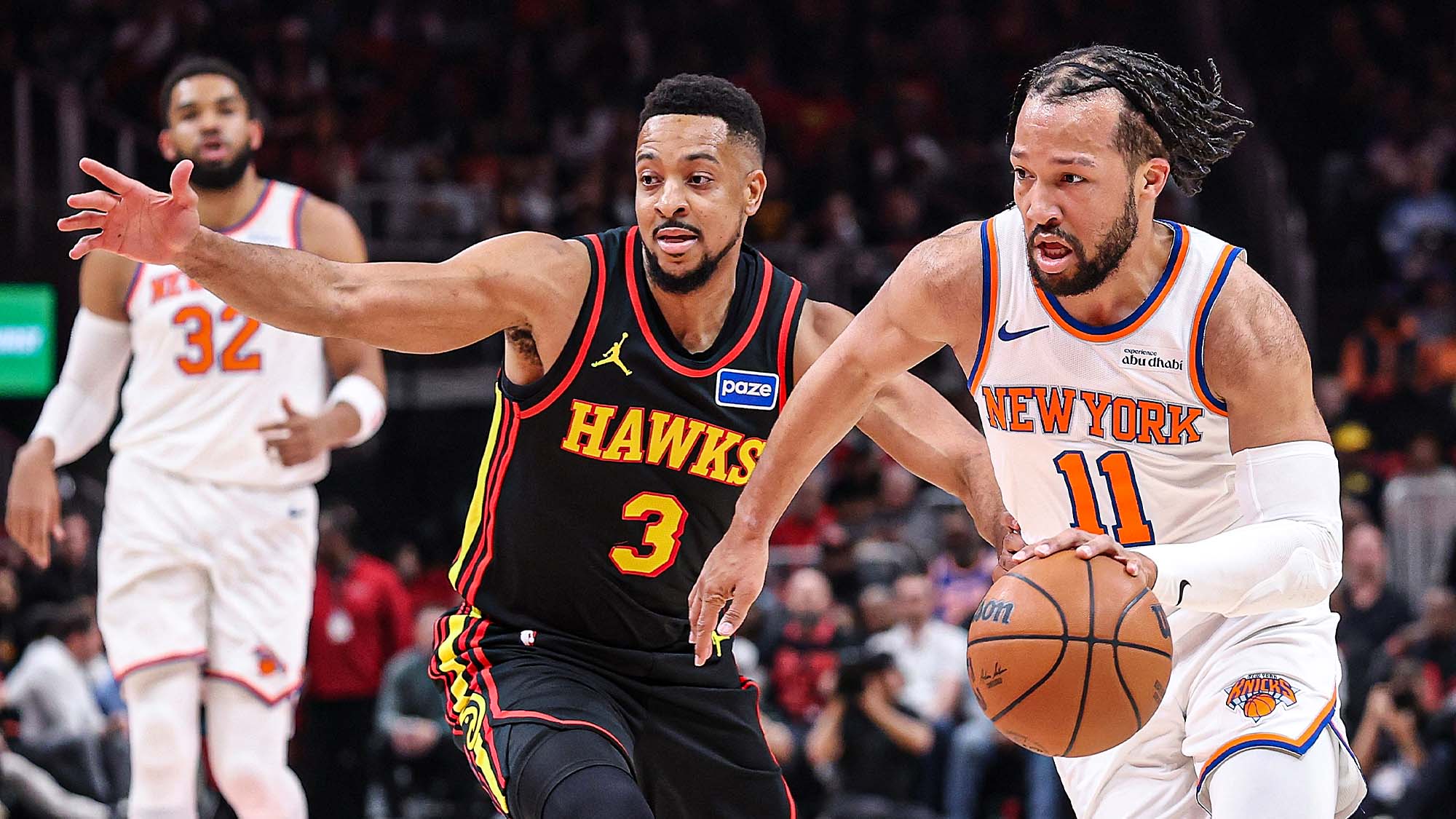
The Atlanta Hawks posted the NBA’s third-best record after the All-Star break (20-6).
Now, they’re the New York Knicks’ first-round opponents in the 2026 playoffs.
It isn’t exactly the cakewalk that New York thought they would get when they secured the No. 3 seed in a top-heavy Eastern Conference.
In Knicks X-Factor’s first-round series preview, we highlight five keys that will tell the story of this must-see playoff matchup.
1. Focus on scoring in the paint
One of the main weaknesses in Atlanta’s roster is the collective lack of size. We saw this in the Knicks and Hawks’ most recent matchup, when Karl-Anthony Towns went off for 21 points on 75% shooting against Atlanta’s 6-foot-10 center, Onyeka Okongwu.
Protecting the basket remains an area where the Hawks are vulnerable, even while playing some of the NBA’s best defense over the past few months.
Over their All-Star break turnaround, it isn’t the Hawks’ offense that has propelled them, but their defense. Since the All-Star break, Atlanta ranks 11th in offensive rating (118.3) and second in defensive rating (108.6).
The main sources of this elite defense have been the Hawks’ ability to guard the three-point line and force turnovers. They are third in opponent turnovers per game (16.5) and fourth in opponent made threes per game (11.8) since the All-Star break.
However, the Hawks’ paint defense has remained vulnerable over this span, as they rank just 16th in the NBA with 50.5 points per game allowed in the paint. It is the worst mark among the East’s top six seeds.
Atlanta’s perimeter defense will be pesky for the Knicks. Open threes will be hard to come by, and the Hawks will force some turnovers to ignite fastbreaks. But the Knicks can make up for these issues by dominating in the paint.
Between Towns, Jalen Brunson, Josh Hart, OG Anunoby, and Mitchell Robinson, the Knicks have the right offensive weapons to bully Atlanta’s undersized lineup with some old-school playoff basketball. Physicality, not finesse, is the key to New York’s offensive success in this series.
2. Dominate the minutes without Dyson Daniels
Despite the offensive heroics of All-Star Jalen Johnson (22.5 PPG) and Most Improved Player candidate Nickeil Alexander-Walker (20.8 PPG), it’s actually wing stopper Dyson Daniels who ignites the Hawks to their best basketball.
According to Basketball Reference, the Hawks are 11.2 points per 100 possessions better with Daniels on the court than off, which is the best mark among Atlanta players to log at least 500 minutes. The Hawks are a +6.5 with him on compared to a -4.7 with him off.
It’s hardly surprising, since we know that it’s Atlanta’s defense that has sparked them to their elite post-All-Star performance. Daniels is the Hawks’ best defender, and one of the best defenders in the league, so it makes sense that he is the key to their success.
The Hawks’ defense is stingy with Daniels on the court, while his ability to force turnovers (2.5 steals per game since 2024) helps create easy baskets for the offense. The Knicks will have their hands full against any lineups featuring Daniels.
When Daniels sits, though, the Knicks should have a major advantage, and that’s when they need to build their advantage on the scoreboard.
Atlanta’s depth is not nearly as strong as New York’s, and that is reflected in their performance without Daniels. When they play with Daniels on the court, the Hawks have a net rating equal to the Knicks’ season-long mark, and when he sits, their net rating sinks to a New Orleans Pelicans-esque level.
When the Knicks have second-unit players like Miles McBride, Jordan Clarkson, and Landry Shamet going up against the likes of Gabe Vincent and Zaccharie Risacher, they need to build some pillowy cushions for the starting lineup to work with.
3. Limit transition chances (prioritize ball security)
The Hawks love to run and gun. They ranked fourth in the NBA with 28.4 points per game in transition.
Atlanta isn’t necessarily the most efficient transition offense, as they placed 16th with 1.15 points per possession in transition. However, they were able to get out in transition for an impressive 24.8 possessions per game, the fourth-most.
This, of course, is a byproduct of the Hawks’ fifth-place ranking in steals per game (9.4). Their aggressive perimeter defense, led by Dyson Daniels, creates transition opportunities for the offense.
This is why the Knicks’ offense has to be their best defense. As long as New York protects the ball offensively, they can prevent Atlanta from getting to their bread-and-butter on offense, the transition game, forcing them to score from the halfcourt.
The Knicks protected the ball well in the regular season, ranking sixth-best with 13.6 turnovers per game. This was buoyed by Jalen Brunson, whose 2.4 turnovers per game as a high-usage starting point guard is an absurdly impressive number.
In their games against the Hawks, though, it was Atlanta’s defense that prevailed in the turnover department. Across three matchups, the Knicks averaged 15.3 turnovers per game.
The good news, though, is that the Hawks only got 8.3 steals per game out of those turnovers, which is over a full steal below their season average. As long as the Knicks’ turnovers are not live-ball turnovers, they should prevent the Hawks’ offense from getting too many easy buckets in transition.
A promising sign for New York in this department is that Brunson has done a great job of protecting the ball against Daniels. Over the last three seasons, across 284 possessions when guarded by Daniels, Brunson averaged just 1.9 turnovers per 75 possessions.
Dyson did a fantastic job of limiting Brunson’s overall production, as Brunson averaged just 20.9 points and 3.7 assists per 75 possessions on a 54.2% true shooting percentage. For the Knicks, though, the quickest way to lose this seven-game series would be to consistently yield high-percentage shots to the Hawks by way of turnovers on offense, so Brunson’s turnover number is the most crucial.
As long as the Knicks can keep the games bogged-down and physical, they should have a very high chance of prevailing in the series. Brunson’s outstanding ball security against Daniels will help them pull that off.
4. Maximize advantage on defensive glass
The Hawks are a subpar offensive rebounding team, as they ranked 20th in the NBA in offensive rebound percentage, per Basketball Reference.
The Knicks, on the other hand, are an excellent defensive rebounding team, placing second in the NBA in defensive rebounding percentage.
This is a mismatch the Knicks must ensure they completely maximize.
Atlanta is an athletic, skilled team on both ends of the court. They will get their share of steals and go on their share of runs offensively.
But if the Knicks consistently own the defensive glass, they will rack up significantly more shot attempts than the Hawks, and that will be difficult for Atlanta to overcome throughout a seven-game series.
However, if New York squanders this advantage and allows the Hawks to start gaining some confidence on the offensive glass, things could get messy.
The Hawks have not exploded on the offensive glass too often, but when they do, they’re tough to beat. They’re 11-4 when collecting at least 15 offensive rebounds.
On the other hand, when held to fewer than eight offensive rebounds, the Hawks were just 6-9.
Karl-Anthony Towns (8.7, 4th) and Josh Hart (6.0, 15th) finished as two of the top 15 NBA players in defensive rebounds per game. On the other end of the court, Atlanta only has one of the league’s top 40 players in offensive rebounds per game, that being Dyson Daniels (2.4, 22nd).
There is no excuse for the Knicks not to completely dominate the defensive glass. The other end could be tougher for New York to take over, as the Hawks finished 10th in defensive rebounding percentage, but when Atlanta is on offense, second chances should be extremely rare.
Towns will have an advantage in size and rebounding skill over anyone the Hawks throw at him. Meanwhile, Hart is as good of a wing rebounder as you could ask for to counter Daniels’ impact on the offensive glass from the wing.
This may be the Knicks’ biggest mismatch, and they must make the most of it if they want this series to be over quickly and smoothly.
5. Experiment with OG Anunoby on C.J. McCollum
The modern NBA is defined by its unique defensive matchups. Gone are the days when players only guarded their counterparts. Now, this is a league where it is widely believed that the best way to stop seven-foot Karl-Anthony Towns is to put a guard on him.
OG Anunoby, the Knicks’ versatile defensive weapon, will guard a plethora of Hawks players throughout this series. He could be argued as the best option to guard any of Jalen Johnson, Nickeil Alexander-Walker, or C.J. McCollum.
To start, though, the Knicks’ best bet might be to try out Anunoby on McCollum.
Although it is Atlanta’s defense that has sparked their turnaround, the mid-season addition of an efficient veteran scorer in McCollum has also played a huge role. The Hawks are 27-14 with McCollum in the lineup. In red and yellow, he is averaging 18.7 points per game on a 53.2% effective field goal percentage, which is slightly better than his career average.
Why Anunoby on McCollum? Because Anunoby’s length can erase McCollum’s best play type.
McCollum has been stellar when shooting out of a pick-and-roll. As a pick-and-roll ball handler, McCollum is averaging 6.5 points per game, placing 13th in the NBA and leading the Hawks. His 1.00 points per possession on these plays puts him in the league’s 81st percentile.
With his mammoth arms, Anunoby is the perfect defender to stymie McCollum’s shots out of the pick-and-roll. Anunoby has been stellar against pick-and-roll ball handlers this season, yielding just 0.80 points per possession (80th percentile).
To boot, Anunoby has McCollum’s number. According to Databallr, across 135 career possessions against Anunoby, McCollum is scoring just 14.4 points per 75 possessions on a 39.5% true shooting percentage.
McCollum doesn’t generate the most headlines or the flashiest highlights among Atlanta’s offensive weapons, but his reliability is a sneaky cog in their success. With Anunoby, though, the Knicks can erase him, putting pressure on Johnson and Alexander-Walker to carry the Hawks’ offensive load almost entirely on their own.
That would be a recipe for success for New York’s defense. Johnson and Alexander-Walker have never been trusted as primary scorers for a playoff team. It will be a brand-new experience for them, so the Knicks should put as much mental pressure on them as possible by taking away their trusty veteran leader.