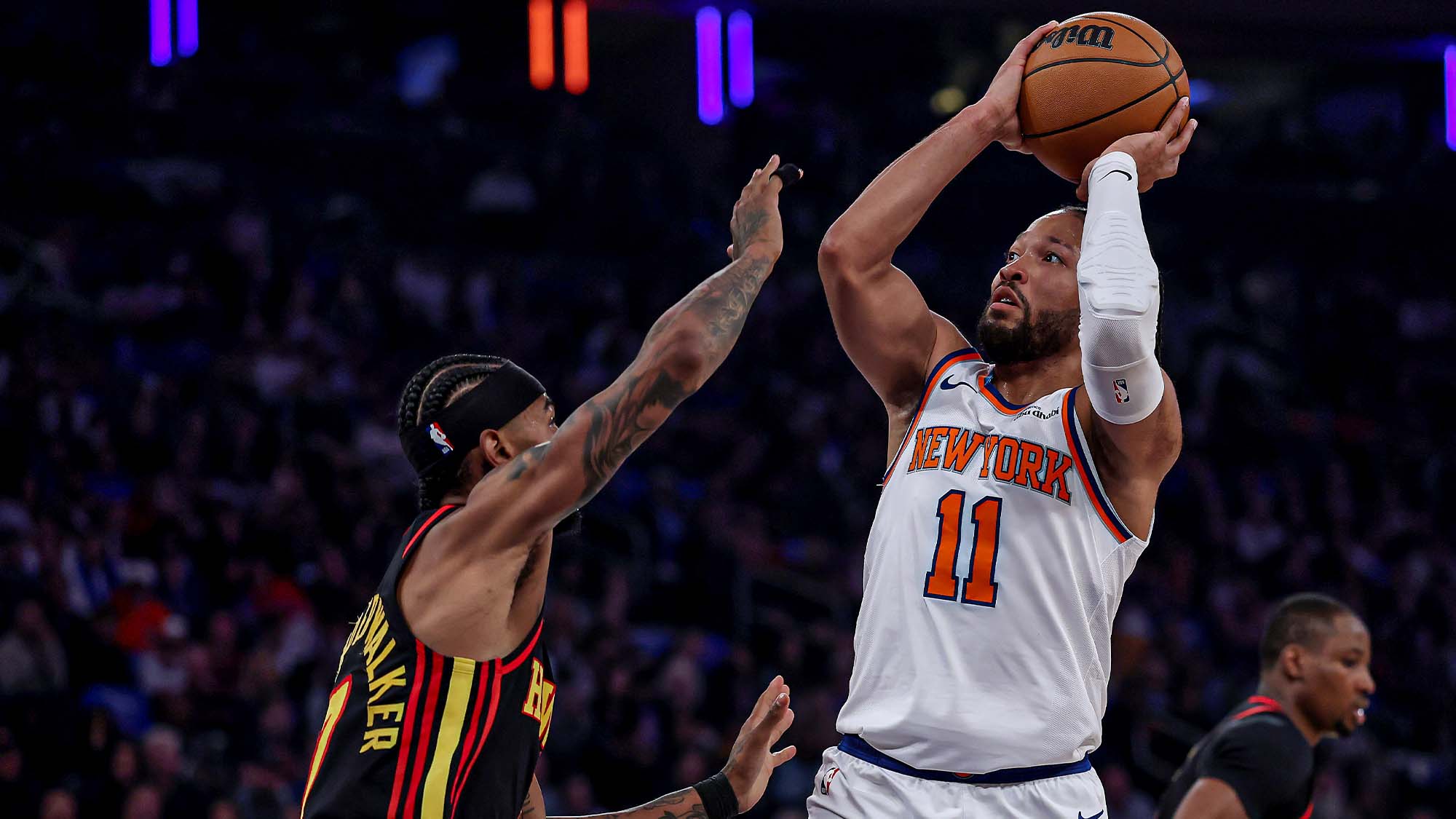
The New York Knicks took a 1-0 series lead over the Atlanta Hawks in their first-round playoff matchup, winning by a score of 113-102 in a game that New York mostly controlled from start to finish.
However, the victory was hardly a flawless blowout. The game was tied early in the third quarter before New York slowly pulled away in the second half. Even when it seemed like the game was out of reach, the Hawks made a valiant comeback to keep Knicks fans in their seats.
New York remains heavily favored in the series, but to ensure they take care of business in Game 2 (8 p.m. EST), they need to address these three issues that sprang up in Game 1.
1. Step up on Onyeka Okongwu threes
A non-shooter for the first five years of his career, Hawks big man Onyeka Okongwu blossomed as a three-point shooter in the 2025-26 season, hitting 37.6% of his attempts on 5.2 attempts per game.
Okongwu was especially precise in his three matchups with the Knicks, connecting on 11 of his 23 attempts from downtown (47.8%). That’s 3.7 makes per game on 7.7 attempts.
This could have easily been written off as a fluke, but in Game 1, Okongwu continued his success as a shooter. He hit 4 of 6 threes on his way to 19 points. Okongwu’s outside shooting was the anchor of his team-best 88.3% true shooting percentage.
Outside of Okongwu’s three-point shots, the Knicks completely smothered Atlanta’s offense. The Hawks shot 42% from the field and 32% from deep just by removing Okongwu’s six threes.
The 25-year-old has now hit 15 of 29 threes (51.7%) across his four games against the Knicks this year. While Okongwu should regress to the mean at some point, the Knicks cannot rely entirely on regression to stop him, not after a four-game sample of prolific shooting against their defense.
It’s on the Knicks’ big men, Karl-Anthony Towns and Mitchell Robinson, to prioritize stepping up and taking away the trailing catch-and-shoot threes that Okongwu likes to take from the top of the key. Both bigs, particularly Towns, were mostly phenomenal on defense in Game 1, but the Okongwu threes are the one thing that have consistently given New York’s defense real trouble across the Atlanta matchups this season.
2. Get Mikal Bridges and OG Anunoby more involved offensively
The Knicks’ core pairing of Karl-Anthony Towns and Jalen Brunson was outstanding in Game 1. The duo combined for 53 points on a 61.7% true shooting percentage, along with 11 assists.
New York frequently ran their offense through the KAT-Brunson two-man game, and it consistently generated high-quality looks not just for the All-Star duo, but for their teammates as well. The Knicks should continue spamming KAT-Brunson pick-and-rolls until the Hawks prove they can stop it.
With that said, New York should expect Atlanta to begin selling out to stop the KAT-Brunson two-man game. Whether that means doubling Towns in the high post or blitzing Brunson, Quin Snyder is not just going to sit around and let the Knicks carve the Hawks up with this two-man game anymore, not after New York dismantled Atlanta both in the April 6 matchup and in Game 1.
If the Hawks do get aggressive to force the ball out of KAT-Brunson actions, it means that the rest of New York’s roster will only get even better looks than they were already getting out of those actions in Game 1.
That means it’s time for Mikal Bridges and OG Anunoby to feast.
With Towns and Brunson combining for 35 field goal attempts and 18 free throw attempts in Game 1, Bridges and Anunoby played minor roles on offense, combining for just 18 field goal attempts and 4 free throw attempts. However, they were extremely efficient with their opportunities, combining for 29 points on a 73.4% true shooting percentage.
Anunoby scored 18 points on 6 of 9 shooting, while Bridges added 11 points on 5 of 9 shooting. The pair also combined for just one turnover.
In anticipation of the Hawks adjusting their game plan to thwart the KAT-Brunson two-man game, the Knicks should be prepared to run sets that generate looks for Anunoby and Bridges.
Both players proved in Game 1 that they can score at efficient clips against their respective Atlanta matchups. So, the Knicks’ offense can benefit by getting more looks from both players, especially if those looks are replacing heavily pressured shots that would otherwise be taken by Brunson or Towns against a defense hellbent on stopping them.
3. Optimize the end-of-game offense
After going back and forth with the Hawks for most of the first three quarters, the Knicks appeared ready to turn the game into a blowout with a run that lasted from the late-third quarter into the late-fourth quarter. With 3:14 remaining, they led by 19.
In a matter of just 95 seconds, that lead had shrunk to 8 with 1:39 remaining.
Much of that was thanks to a red-hot shooting run by the Hawks, who made three consecutive triples, including a contested shot by an average shooter in Jalen Johnson. However, the defensive woes leaked over from a Knicks offense that decided to stop doing the things that gave them their big lead in the first place—an all-too-familiar story for this franchise over the last few years.
From 8:12 to 4:36 in the fourth quarter, the Knicks went on a 15-3 run to extend their lead from 7 to 19. Over that span, not a single point was scored by Jalen Brunson, who, in fact, wasn’t even on the court until the final made field goal of that run (a Karl-Anthony Towns three that Brunson assisted).
Then, the Knicks offense became the Jalen Brunson Show to a fault, and it allowed the Hawks to get back into the game.
After expanding their lead by turning defense into offense and sharing the basketball, New York devolved into an isolation-heavy offense around Brunson. The high-quality shots disappeared.
One possession ended in Brunson throwing a grenade to Josh Hart for a stepback three at the end of the shot clock, which is never the shot New York should be trying to get when they start a possession. This led to Okongwu hitting a trailing three as the Hawks came down the court off the long rebound.
After Hart committed an offensive foul screening for Brunson on the next possession (why is Hart screening for Brunson in a key situation after the Knicks dominated with the KAT-Brunson combo all night?), the Hawks came back with another three.
Next, Brunson came down and forced a very difficult mid-range shot late in the clock, which led to yet another Hawks three in transition. After that, Brunson again forced a tough two-pointer following limited-to-no ball movement for the duration of the shot clock, giving the Hawks a chance to cut the lead to 5, which they did not take advantage of.
This has been a frequent issue for the Knicks during the Brunson era. As clutch as The Captain is, New York has a bad tendency to become over-reliant on him in certain situations, particularly when the team is leading and looking to ice a game. It opens opportunities for opponents to crawl back into games that they should have no business crawling back into.
In Game 1, the Knicks inexplicably abandoned the tendencies that built their big lead, favoring a low-efficiency offense built around Brunson isolations with few or no actions involved. Towns’ lack of involvement was particularly noticeable.
It is understandable that the Knicks are prioritizing milking the clock and protecting the ball when they have a 19-point lead with under five minutes left. This is likely their justification for leaving the ball in Brunson’s hands in these situations: With his elite ball handling and ball security, they know he will avoid a live-ball turnover for easy transition points and successfully milk around 24 seconds off the clock, while still having a decent chance to score thanks to his self-creation skills.
But there are ways to protect the ball and milk the clock while still playing team basketball and finding a good shot. Instead of counting on Brunson to dribble the ball for 24 seconds, the Knicks can do a better job of getting into their actions with 10, or even 8 seconds on the shot clock.
Let Brunson walk the ball up the court and milk a few extra seconds. That’s all well and good. But then, why not get back into the sets that have been working all game? Pursue high-quality shots. As good as Brunson is, a contested long two-pointer by Brunson is not a more efficient shot than a wide-open Towns three or a cutting Anunoby dunk.
Mike Brown needs to put his foot down and ensure things change in these situations. Fans can point fingers at Brunson all they want, but Brown and his staff are enabling it. These late-game possessions are a strategic move on the part of Brown, not Brunson being a “ball hog.”
The Knicks got away with it this time, but against better teams (or even against the Hawks, if their lead is smaller than 19), their lethargic late-game offense could come back to bite them. They must eliminate their tendency to become overly Brunson-centric when protecting a lead, and figure out ways to continue chasing high-quality shots while still successfully milking the clock and protecting the ball.
With the talent at their disposal, it should be an easily achievable goal.