

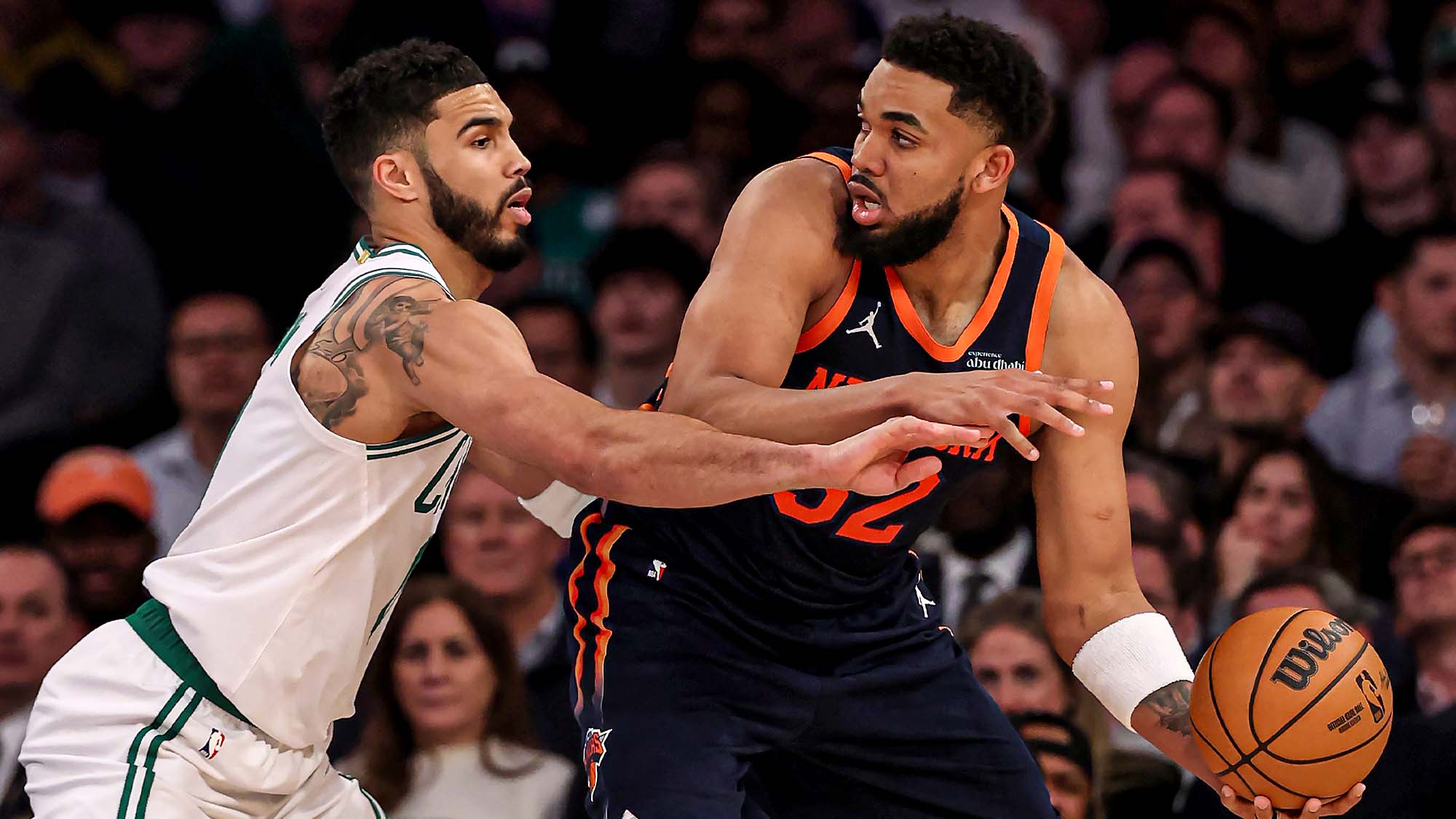
The New York Knicks have a chance to send a message to the Eastern Conference as the playoffs close in.
With a win over the Boston Celtics on Thursday night, the Knicks can show the NBA world that they are ready for a serious title pursuit.
The Celtics have been red-hot since the return of Jayson Tatum on March 6. With Tatum in the lineup, Boston is 13-2 with an average point differential of +10.9.
Here are New York’s three keys to pulling off the statement win over a Tatum-led Celtics team.
1. Crash the offensive glass
One of Boston’s biggest improvements since Tatum’s return has been their defensive rebounding. Since March 6, the Celtics rank second in the NBA with a 74.8% defensive rebounding rate. Before Tatum’s return, they ranked 11th at 70.0%.
Tatum is averaging an astronomical 9.3 defensive rebounds per game, on pace to be a career high. If he qualified, he would rank third in the NBA behind Victor Wembanyama (9.5) and Nikola Jokic (10.0).
Rebounding isn’t the first thing you think of when evaluating Tatum’s potential impact on a game, but as surprising as it may be, it truly is the area where Tatum has provided the Celtics with the most significant boost. His return has helped the already-elite Celtics defense become dominant at limiting second opportunities, making them incredibly difficult to score on.
Against a Boston defense that is loaded with stoppers, the Knicks cannot afford to take one shot every time down. They must give themselves second chances to maximize their chances of outscoring a high-octane shooting team like Boston.
Since March 6, the Celtics are allowing just 11.8 second-chance points per game, ranking second-best in the NBA. The only team faring better? That would be the Knicks (11.4).
Given how well the Knicks are doing at preventing second-chance points, they have an opportunity to gain a major advantage in this category if they can hone in on the offensive glass and rack up plenty of their own second-chance points.
Since March 6, the Knicks are third in the NBA with 17.6 second-chance points per game. Their +6.2 margin in second-chance points leads the NBA over this span.
New York must aim for a similar or better margin against Boston. It will be challenging against a team excelling on the defensive glass, but the Knicks have the horses to do it; they boast two of the NBA’s top six players in offensive rebounds per game, Mitchell Robinson (4.2) and Karl-Anthony Towns (3.1).
If Mitch and KAT dominate the offensive glass, the Knicks can gain a large edge in the second-chance points department, which could be enough to tilt the tide in New York’s favor.
2. Get out in transition
The Knicks are one of the NBA’s more methodical offensive teams, ranking 25th in pace this season (98.0). They are slowing the pace even more as the playoffs approach; over the last month, they are 30th in pace (95.4).
Ranked 29th in pace over that span? Boston (95.7).
We can expect Thursday’s matchup to mostly be a half-court affair. But if the Knicks want to exploit one of Boston’s few weaknesses, they should make an effort to increase the tempo.
On the year, the Celtics are allowing 1.14 points per possession in transition, which ranks 11th-worst in the NBA and fourth-worst among the 12 teams that currently possess a top-six seed. They particularly struggle with fouling in transition; Boston commits a shooting foul on 13.2% of transition possessions, which is better than only the Brooklyn Nets.
The Celtics work around this issue by preventing transition opportunities altogether. Boston’s opponents average 19.0 transition possessions per game, fifth-fewest in the NBA, which is why they rank fourth-best with only 21.6 points per game allowed in transition despite being in the bottom half of most per-possession efficiency categories.
Boston commits a league-low 12.3 turnovers per game, which is the main reason why they have done such a good job of preventing opponents from getting out in transition. They are especially stellar at avoiding live-ball turnovers; their opponents collect just 6.1 steals per game, the fewest in the NBA.
The Celtics’ shaky transition defense hasn’t been a problem because they rarely have to rely on it thanks to their excellent ball security on offense. So, the challenge for the Knicks is to figure out how to make Boston play transition defense.
That has to start with forcing live-ball turnovers defensively.
This is something the Knicks have been unable to do against Boston so far, despite their 2-1 record in the series. New York is averaging 5.7 steals per game against the Celtics, even lower than Boston’s season average for opponent steals per game.
Thursday is the Knicks’ opportunity to test the waters before a potential playoff series and see if they can scheme up opportunities for their wing defenders, namely OG Anunoby and Mikal Bridges, to play aggressively on the perimeter in pursuit of steals.
If successful, not only would it help limit shot opportunities for Boston’s three-point-happy offense, but it would tee up extra chances for the Knicks’ offense to attack one of the rare weak spots in Boston’s defense.
As an added bonus, it would probably get the Celtics’ stars in foul trouble, too, given Boston’s 29th-ranked foul rate in transition.
3. Deny above-the-break threes
While we have seen some progress in recent weeks, the Knicks’ defense has struggled to guard the three-point line this year. On the season, they still rank 11th-worst with a 36.1% opponent three-point percentage. It’s the third-worst mark among teams that currently possess a top-six seed.
Quite obviously, that can be problematic against a Celtics team that ranks third in made threes per game (15.2).
It goes without saying that New York must figure out how to successfully defend the perimeter against Boston if they wish to win on Thursday (and, more importantly, in a potential playoff series). To be more specific, though, the Knicks must hone in on Boston’s above-the-break threes.
Not only is it a good bet that Boston will shoot a three when they come down the court (they rank fourth in the NBA with 46.3% of their field goal attempts coming from downtown), but you can rest assured that they are probably trying to shoot from above the break, not from the corner.
The Celtics are taking a league-low 16.2% of their threes from the corners, meaning they take a league-high 83.8% from elsewhere. This is a completely different strategy from any other NBA team; the gap between Boston’s corner three rate and the 29th-ranked Wizards’ corner three rate (20.8%) is 4.6%, larger than the gap between the Wizards and the 12th-ranked Warriors (25.2%).
So, it’s almost a 50-50 bet that Boston wants a three when they come down, and from there, it’s over an 80-20 bet that they will not shoot from the corners.
That makes it easy for the Knicks to understand what their defensive game plan should focus on. It does not mean that stopping those shots will be easy, or else every team would be doing it by now, but it does mean that the Knicks should know what to prioritize.
Guarding the corners and the rim can take a back seat. Whatever you must do to guard those threes from the elbows and the top of the key, that is what you must focus on to beat Boston.