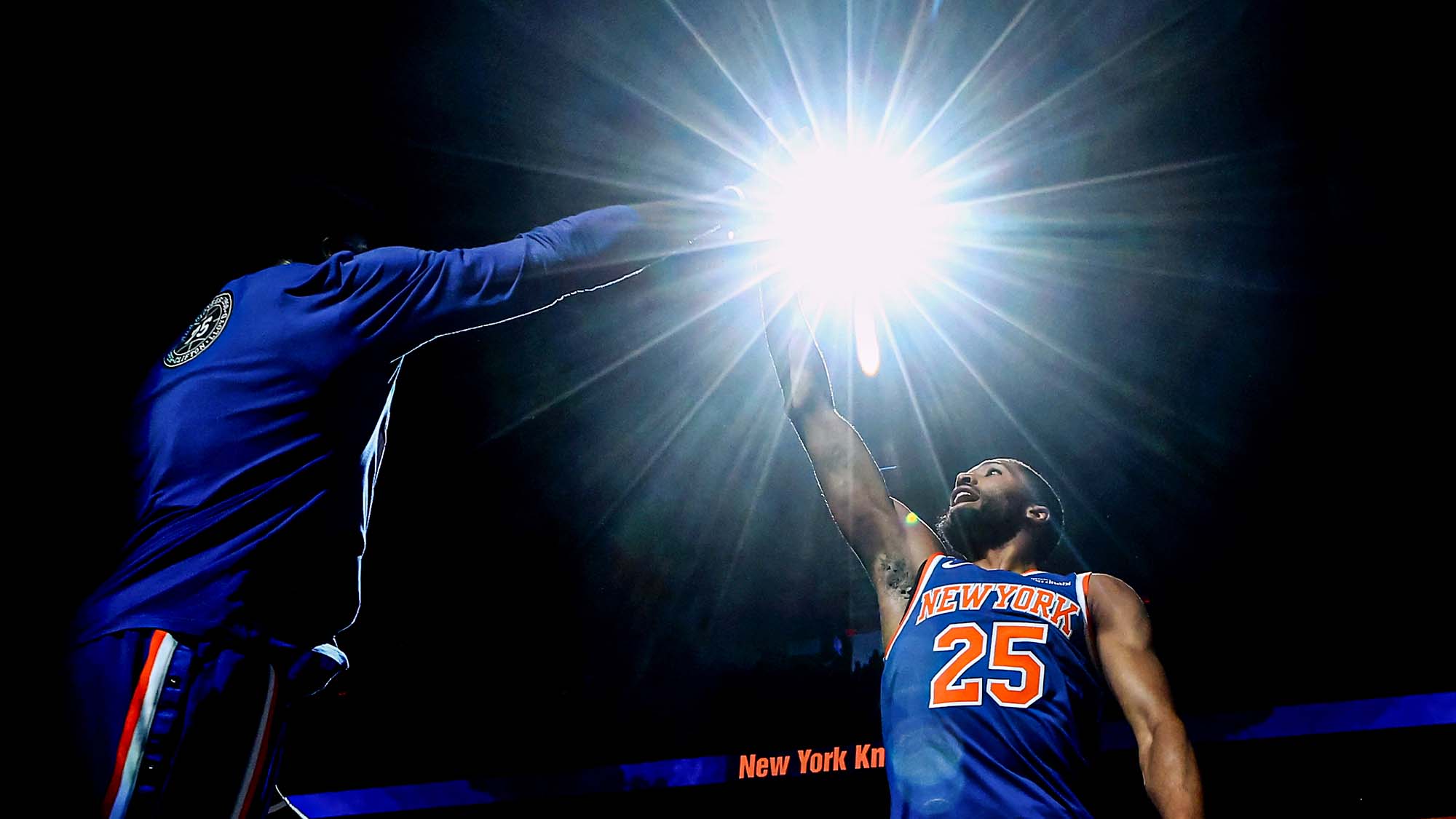
The New York Knicks’ pre-All-Star break run was a mixed bag.
A 35-20 record is hardly anything to sneeze at. However, the Knicks are currently just third in the Eastern Conference standings, despite being listed as the pre-season favorites to win the East title. They are a whopping six games behind the top-seeded Detroit Pistons, whom they defeated in last year’s first round. New York is as close to seventh in the East as they are to first.
Granted, the Knicks are only a half-game behind the Boston Celtics for the second seed. Still, the Knicks have not placed the stranglehold on the East that they were expected to after Jayson Tatum and Tyrese Haliburton’s injuries.
New York fired Tom Thibodeau and replaced him with Mike Brown in hopes that the switch would spark the team’s returning core to new heights. But the team is currently two games worse than it was through 55 games last year (37-18), despite the weakened competition in the East.
In fairness, the Knicks’ +6.3 net rating is a 2.1-point improvement on their final mark from last year (+4.2), which represents a four-spot jump from eighth-best in the NBA to fourth-best. That’s a promising sign moving forward. Still, Brown was brought in to improve the team’s win percentage, not its point differential.
If the Knicks want to establish themselves as the true title contenders they have the potential to be, they must fix these two things after the All-Star break.
1. Find a way to build a quality defense around Jalen Brunson
The presence of the Knicks’ team captain has essentially zero effect on their performance. Suffice to say, that isn’t a great place to be entering the playoffs. You want your best player to elevate the team.
According to Databallr, the Knicks have the exact same net rating (garbage time-adjusted) whether Jalen Brunson is on the court or off: +6.7.
Offensively, Brunson’s impact is right where it needs to be. The Knicks score 7.2 more points per 100 possessions when he is on the court than when he is off.
The problem is that Brunson’s defense negates his offensive impact. New York also allows 7.2 more points per 100 possessions with Brunson on the court than when he is off, identical in weight to the boost he provides on offense.
With Brunson on the floor, the Knicks score a blistering 123.6 points per 100 possessions, which is better than the offensive rating of the league’s best offense (Nuggets, 122.2). That’s wonderful. The problem is that they allow 116.9 points per 100 possessions with Brunson on the floor, which would rank 21st in the NBA.
Brunson is capable of anchoring a league-best offense. That will take the Knicks far, but they may eventually hit a wall against the league’s elites if they continue playing 21st-ranked defense with their best player on the court.
New York’s offense is much less prolific without Brunson, scoring 116.5 points per 100 possessions (would rank 12th), but their defense instantly upgrades to elite-caliber just by taking Brunson off the floor. The Knicks’ defensive rating without Brunson is 109.8, which would be third-best in the league behind Oklahoma City and Detroit.
This has to be fixed if the Knicks want to give themselves a serious shot at winning four straight best-of-seven series.
Brunson is going to carry a heavy workload in the playoffs. His minutes will likely increase, as will his shot volume. He will have less energy to work with than he does in the regular season, which should only make him more of a liability on defense.
If the Knicks cannot craft lineups and schemes that allow them to play sufficient defense with Brunson on the floor, they will find themselves in plenty of shootouts. Their offense is good enough to win many of those shootouts, but if they want to consistently maintain the upper hand across consecutive seven-game series, they must be able to win some gritty games when the shots aren’t falling, too.
One tweak the Knicks could try is giving Brunson more minutes alongside Landry Shamet. Across 349 minutes with Brunson and Shamet on the court, the Knicks’ defensive rating is a very solid 113.6 (would rank 10th in the NBA), their best two-man mark among the 12 players who have logged at least 100 minutes with Brunson.
New York could also stabilize the defense by ensuring Brunson doesn’t play any more minutes with Jordan Clarkson. The Knicks have an untenable defensive rating of 120.0 (would rank 28th in the NBA) across 384 minutes with Brunson and Clarkson on the court.
Clarkson’s playing time has been reduced recently—he was benched completely until injuries forced him back out there—and his benching coincided with a major uptick in the Knicks’ defensive production. Shamet’s return also played a role in the hot defensive stretch.
Perhaps less of Clarkson and more Shamet is all the Knicks really need to field a respectable Brunson-led defense.
2. Generate more free throw attempts
New York has the NBA’s third-best offensive rating (120.0), according to Basketball Reference. But they’re capable of being even better than that—and with their concerns on defense, they must maximize every advantage they can get on offense.
The Knicks are thriving in most areas of offense. They rank top-10 in effective field goal percentage, turnover rate, and offensive rebounding rate.
The one weakness is their lack of points from the foul line. New York ranks 24th with a .192 ratio of made free throws to field goal attempts. They are also 23rd with just 17.4 made free throws per game.
The average trip to the free throw line is much more efficient than the average shot from the floor, so the more field goal attempts that an offense can convert to free throw attempts, the more points they will score. Sustaining a high free-throw rate is a great way to ensure a high offensive floor from game to game, as foul shooting is a much more stable thing to count on than jump shooting.
Each of the clear-cut top three teams in the NBA this year—Detroit, San Antonio, and Oklahoma City—ranks top-10 in free-throw rate, proving it is the type of reliable trait that can play an instrumental role in sustained winning.
New York’s third-ranked offensive rating is indicative of the team’s ceiling on that end of the court, but their consistency can stand to improve. While the Knicks have registered the third-most games with 130+ points (13), they have also tied for the 11th-most games with under 100 points (5), and they’re winless in those games. Two of them came against the Pistons.
Racking up more free throws is a great way to ensure one of those sub-100-point games does not pop up at a critical juncture in the playoffs.
Many Knicks players need to step up their game when it comes to drawing fouls. It all starts with Jalen Brunson.
The captain is down from 6.9 free throw attempts per game in 2024-25 to 5.7 this season, and that’s despite jumping from 18.5 field goal attempts per game to 20.5. His .280 free-throw attempt rate is his lowest as a Knick, and since he’s tied for his career-best free-throw percentage at 84.7%, it means he is leaving a lot of points on the floor by turning free throws into jumpers.
Brunson is capable of better in this department, but at least he is still doing a solid job. The more pressing matter is that the Knicks are getting nothing from Mikal Bridges, whose foul-drawing continues to be anemic for a player of his shot volume.
Bridges is taking 1.3 free-throw attempts per game on 12.6 field goal attempts per game. That’s a .101 rate, basically identical to his .100 mark last year. He is taking the fewest free throws per game in the NBA this season among players who average last 12 field goal attempts per game.
It’s a bizarre decline for Bridges, whose career free-throw rate before joining the Knicks was .233, more than double his career mark in New York. He was trending up in Brooklyn, too, flashing star-caliber foul-drawing in his 27-game run to close the 2023 season, when he averaged 6.6 free-throw attempts per game on 18.6 field goal attempts (.356 rate, identical to Kevin Durant’s rate as a Warrior).
Everyone can step it up, though. Outside of Brunson and Karl-Anthony Towns, no other Knick is averaging more than 3.5 free-throw attempts per game (OG Anunoby).
Be it through play-calling, scheme, or a shift in the players’ individual mentalities, the Knicks must start racking up more free throws if they want to be a consistently dominant offensive team from game to game. Consistency is what will allow them to translate their elite offensive rating into an equally elite win-loss record.