
Down two starters, the New York Knicks took a beating in Detroit from the top-seeded Pistons on Friday night.
Now one game behind the Boston Celtics for the East’s second seed, the Knicks need a bounce-back win in Beantown to pull back into a tie for No. 2 in the conference. Here are their three keys to pulling it off.
1. Don’t allow a three-point barrage (particularly above the break)
Few teams like to shoot from outside as much as the Celtics. They rank second in the NBA with 42.4 three-point attempts per game. Their 46.5% three-point attempt rate is third-highest.
If your defense allows Boston to rack up looks from behind the arc, it could be a long night. With so many talented shooters to throw at you, the Celtics are bound to get hot at some point if you let them shoot threes at a high volume.
When the Celtics attempt at least 50 threes this season, they’re 8-1 with an earth-shattering point differential of +20.2. With fewer than 50 three-point attempts, they’re 26-17 (.604) with a much more human point differential of +4.5.
The more threes Boston takes, the better they get at knocking them down. They are shooting 38% from deep in games where they take 50+ threes, compared to 36.2% in all other games.
While I could not present you with a foolproof plan to stop one of the greatest three-point shooting basketball teams in world history, I can tell you this: Any plan to stop the Celtics’ outside game has to start with their above-the-break shots.
Boston shoots an NBA-low 14.9% of their three-point shots from the corners. This is so far behind the rest of the league that the margin between them and the 29th-ranked team is equal to the margin between No. 29 and No. 19.
The Celtics shoot a mind-boggling 36.1 above-the-break threes per game, which, of course, leads the NBA by a country mile. It is critical for the Knicks to focus on running Boston’s shooters off the line when defending this part of the court. Almost nine times out of 10, this is where the Celtics want to shoot threes from—not the corners.
Let them take a mid-ranger shot. Heck, let them shoot a layup or get to free-throw line. Whatever you do, just take those threes away. Boston basketball is built upon the concept that they will simply out-math you by taking an absurd quantity of threes. If you hold them to twos, that strategy falls apart.
2. Get them in foul trouble
The Celtics don’t have many weaknesses as you scout them on each end of the court. They excel in a plethora of categories.
One area where Boston is pedestrian, though, is the foul department. They commit 20.0 personal fouls per game, ranking 15th in the league.
Add in the fact that their opponents commit just 18.5 fouls per game (fourth-fewest), and the Celtics’ -1.5 differential in fouls per game ranks 25th in the NBA.
When the Celtics commit at least 23 fouls, they’re 7-8, including 2-4 at home. They took home losses to the 76ers and the Nets in games where foul trouble was an issue.
On Friday night, the Knicks were only able to draw 21 fouls on a Pistons team that leads the NBA with 22.5 fouls per game. Of course, the absences of Karl-Anthony Towns and OG Anunoby played a large role in this.
If Towns and Anunoby are back in Boston, the Knicks should have the offensive firepower they need to put the Celtics’ defenders on their heels.
Back on opening night, when the Knicks ran the Celtics out of MSG, they drew 25 fouls. In their December loss at Boston, the Celtics only committed 20 fouls.
Slowing the game down with fouls is an excellent way to break the rhythm of a three-point-heavy offensive team like Boston. It also generates high point-per-possession opportunities from the foul line, which are helpful to keep up with a team that scores points in bunches.
3. Secure the defensive glass (especially on the perimeter)
Part of what makes the Celtics’ offense so difficult to stop is that they get a ton of offensive rebounds despite being a high-volume three-point-shooting team. That’s something you don’t see often. If a team can pull it off, it’s something of a cheat code.
Three-pointers are supposed to be tougher for the offense to rebound. It’s an overlooked factor that diminishes their efficiency in comparison to shots near the rim, which are rebounded by the offense more frequently.
But if you’re launching a ton of threes and still getting those valuable second chances, you’ve broken the game of basketball.
Boston ranks sixth-best in the NBA with a 29.3% offensive rebounding percentage, per Basketball Reference.
The key to Boston’s offensive rebounding excellence is that just about everyone on the court contributes. They have seven players ranked in the top 150 of offensive rebounds per game, tied with the Nets for the most in the NBA. That doesn’t even include the newly acquired Nikola Vucevic, who would be their league-high eighth member in that club if current numbers hold.
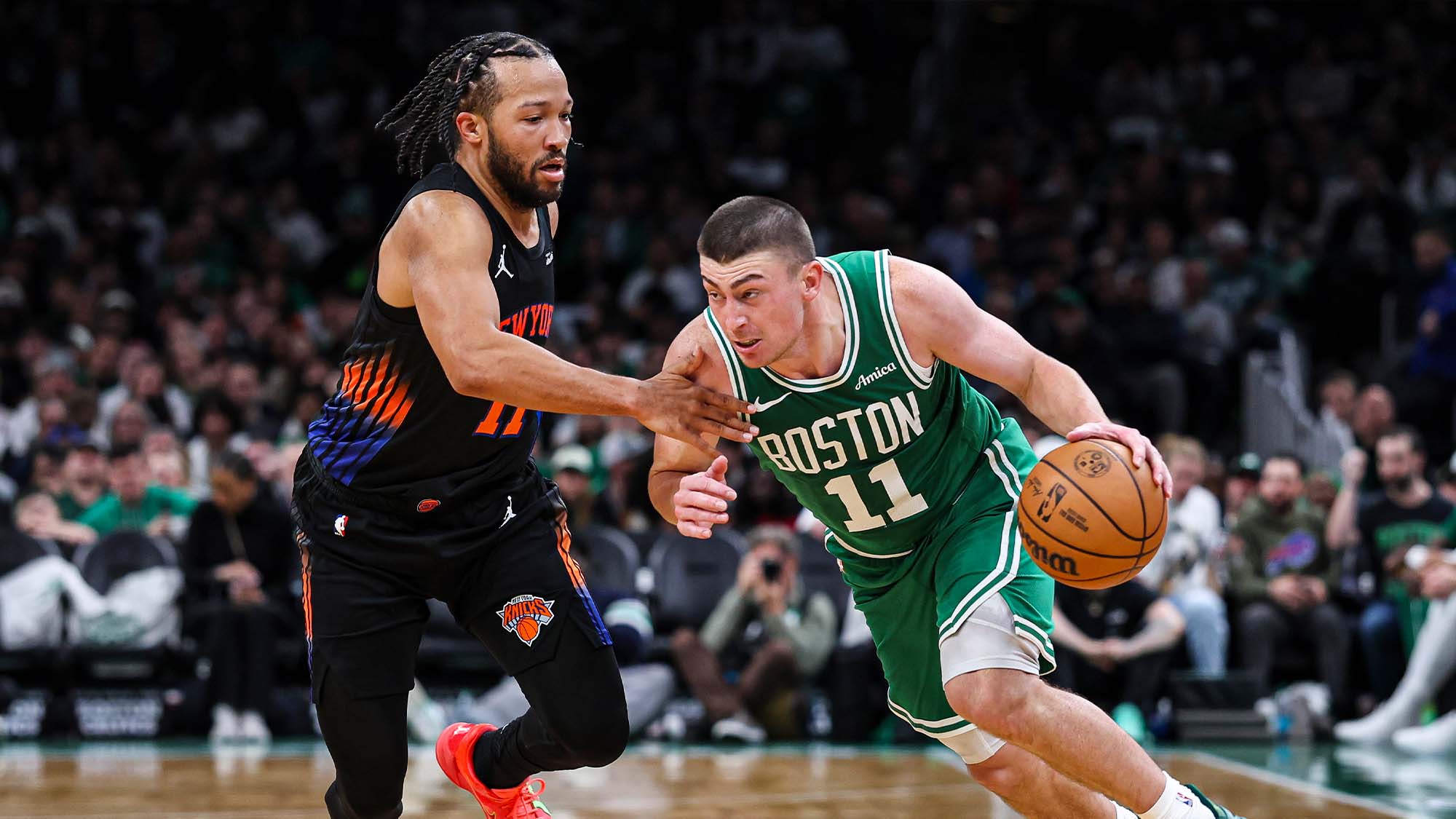
This means that the Knicks’ non-bigs must be alert when Boston’s shots go up. The Celtics’ backcourt players, such as Jaylen Brown, Derrick White, and Payton Pritchard (a trio that combines for 3.1 offensive boards per game), will be crashing the glass, anticipating a long rebound off of missed threes.
New York needs to emphasize boxing out on the perimeter. Players not known for their rebounding, like Mikal Bridges and Jalen Brunson, must anticipate that the Celtics’ guards and wings will be looking to sneak in for those awkward pinball rebounds on short threes.
Remember when we discussed how dominant the Celtics are when they jack up at least 50 threes? Well, oftentimes, when they manage to shoot that many treys, it’s thanks to second chances. Boston averages 15.3 offensive rebounds in games when they shoot 50+ threes, compared to 12.2 in all other games. Those three extra looks could be all the Celtics need to get hot from downtown and start a handful of runs that otherwise wouldn’t happen.
Crashing the defensive glass must be a priority for the Knicks tomorrow afternoon, particularly for the non-bigs.
