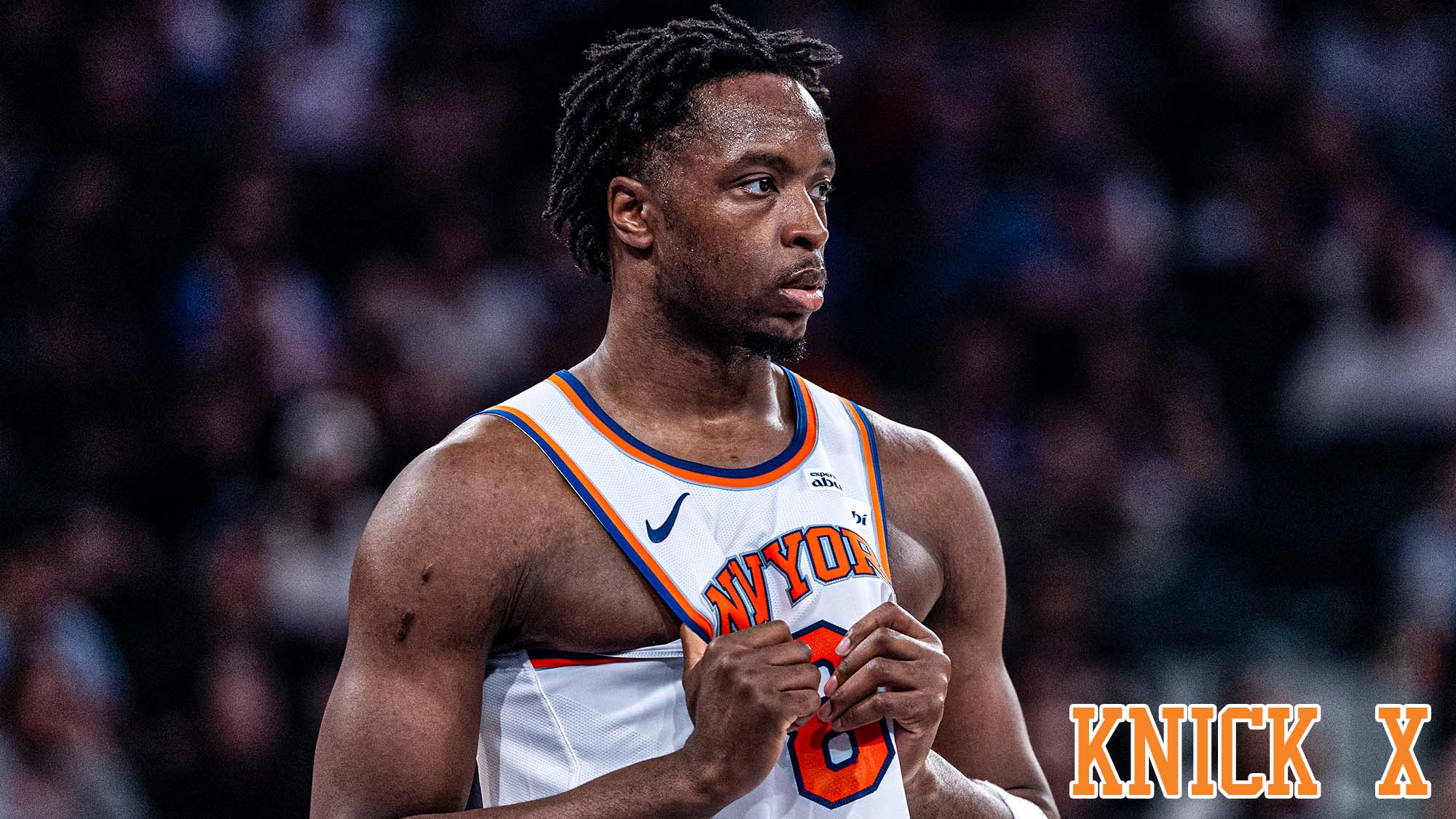
The New York Knicks will be without OG Anunoby (hamstring) for a minimum of two weeks, at which point the team will re-evaluate its $212.5 million forward.
Anunoby exited early in the team’s Friday night game against the Miami Heat. With Jalen Brunson already ruled out, New York had a chance to prove it could fight through adversity, and Mike Brown’s squad rose to the challenge. The Knicks rallied to a 140-132 victory without two of their four best players.
Now, the Knicks will have to continue proving they can stay afloat without Anunoby for at least two more weeks.
While Anunoby’s injury is unfortunate, it was inevitable that he’d eventually miss time, as the ninth-year forward missed at least eight games in each of his first eight NBA seasons. For New York, it could be a blessing in disguise to have Anunoby miss time early in the season, as the team can experiment with ways to work around his absence before the stakes get higher in the spring.
Here are three Knicks trends to watch closely during Anunoby’s time on the sidelines.
Can Landry Shamet continue offering all-around offensive creation?
With Brunson and Anunoby out on Friday, the Knicks had over 33 field goal attempts per game to replace. The main beneficiary was, to everyone’s surprise, Landry Shamet, who went full Monstars mode as he absorbed Brunson and Anunoby’s superpowers on a career night.
Shamet dropped a career-high 36 points in 37 minutes off the bench, making 12 of 19 field goal attempts. Shamet hit 6-of-12 from deep, 6-of-7 from two, and 6-of-6 from the stripe. It’s tied for the eighth-most points off the bench in Knicks history, and the most since J.R. Smith had 37 in a March 2013 win over the Bobcats.
Can Shamet keep this up?
In terms of scoring 36 points per game on 63% shooting, the answer is no. Sorry for the spoiler.
But if Shamet can provide a steady scoring punch in Anunoby’s absence, it would go a long way toward replacing No. 8’s offensive production.
Friday highlighted the silver lining of Anunoby missing time this early in the season. The Knicks have already learned that Shamet, a guy who spent most of last year in Tom Thibodeau’s doghouse, might be capable of stepping up as a primary scoring option in an emergency. If he can sustain that level of play, it would provide the Knicks with valuable knowledge as they march toward the playoffs, giving them a fallback plan for a rainy day.
The primary aspect of Shamet’s offensive game to keep an eye on is his scoring inside the arc. Shamet has always been a solid three-point shooter, so it wasn’t too surprising to see him convert 6-of-12 threes on a night where injuries directed more shots his way.
The real surprise was that Shamet made six two-pointers, most of those being self-created off his own drives. Shamet had a series of pull-up mid-range jumpers and a handful of strong finishes around the rim. For a guy who averages 0.99 made two-pointers per game in his career, it was quite a shock to see Shamet aggressively creating his own shots off the dribble.
Anunoby is averaging 4.0 made two-pointers per game in his Knicks career, so New York needs someone to step up and replace his inside scoring as a driver and cutter. Shamet did precisely that on Friday night. If he can sustain that production over the next two weeks, the Knicks will have discovered they’ve had a secret offensive weapon buried on the bench all this time.
Who will replace Anunoby’s defensive playmaking?
Since landing the job in New York, Mike Brown has emphasized hastening the Knicks’ pace. So far, the Knicks are 19th in pace (99.6), up from 26th last season (96.7).
It’s a noticeable jump, even if it isn’t a night-and-day shift. Realistically speaking, this Knicks squad will never rank as one of the top teams in pace, as they have multiple All-Star isolation scorers and excel at offensive rebounding, two factors that will prevent a team from racking up possessions over 48 minutes.
“Pace” is a complex concept that cannot be summed up by the one number that is most commonly referred to (possessions per 48 minutes). Numerous elements go into a team’s pace of play. For the Knicks, Brown’s push for pace is focused on a few specific areas, rather than gunning for the No. 1 spot in the overall “pace” metric.
New York hasn’t sped its game up in every way, but one of the clear differences from last season is the Knicks’ focus on pushing the ball after getting steals. The Knicks are forcing more turnovers and shooting the ball faster after those turnovers.
In the 2024-25 season, the Knicks forced turnovers on 13.1% of opponent possessions, ranking 13th in the NBA. This year, that rate is up to 14.1%, placing ninth.
Last year’s Knicks averaged 6.8 seconds to shoot the ball after forcing a live-ball turnover, ranking 14th in the league. This year, they’ve gone a half-second faster, shooting the ball in just 6.3 seconds after a live-ball turnover, ranking sixth-fastest.
Anunoby has been the primary engine behind this shift.
A former steals champion (1.9 per game in 2022-23), Anunoby has always had a knack for playmaking. Under Brown, though, he’s kicked up his pursuit of steals to an all-new level. Anunoby is averaging a career-high 2.2 steals per 36 minutes. That represents a 47% increase from his 1.5 steals per 36 minutes over his first two seasons in New York.
This shift isn’t exclusive to Anunoby. Mikal Bridges is also averaging a career-high in steals per 36 minutes (2.1). It is apparent that Brown has encouraged the Knicks’ defensive playmakers on the wings to pursue more steals as a way of sparking more transition opportunities on offense.
With Anunoby out, the Knicks will have to replace the multiple steals he generates per game. Who will step up to generate those turnovers? If nobody does, will the offense suffer?
Outside of Anunoby and Bridges, the Knicks don’t have anybody who is averaging close to 2.0 steals per 36 minutes this season. Miles McBride ranks third on the team at 1.4. To replace Anunoby’s production, someone (or multiple players) will have to shift their mentality and play a little more aggressively to recoup the steals that Anunoby would have generated.
Watch closely to see how the Knicks are affected by the loss of Anunoby’s elite ability to force turnovers and spark transition offense.
Can the Knicks survive for 48 minutes per game without Anunoby?
Is it a stretch to say Anunoby might be the Knicks’ most important player?
His impact on the Knicks has been startling since the moment he arrived in January 2024.
New York was playing mediocre basketball in 2023 before Anunoby came along, starting the season 17-15. The trade for Anunoby is what elevated the Knicks into the legitimate Eastern Conference contenders they are today.
Anunoby’s arrival sparked one of the best months of basketball in Knicks history, pushing the Knicks from a .500-ish team to a second-seeded squad that hosted Game 7 of the Eastern Conference Semifinals despite countless injuries (including his own). Ever since, the Knicks’ success has been primarily dictated by whether or not Anunoby is on the court.
As long as the stat has been tracked (since 1996-97), Anunoby is the Knicks’ franchise leader in plus-minus per game at +7.2. Per 100 possessions, the Knicks have outscored their opponents by 9.7 points with Anunoby on the court, compared to 0.6 with him on the bench. That +9.1 on-off margin is far higher than Jalen Brunson (+2.5), Karl-Anthony Towns (+5.9), and Mikal Bridges (+5.1) in their Knicks careers.
So far in the 2025-26 season, Anunoby has been more important to the Knicks’ success than ever before.
New York is outscoring opponents by 14.9 points per 100 possessions with Anunoby on the court. With him on the bench, though, the Knicks have struggled mightily, getting outscored by 8.4 points per 100 possessions. Anunoby’s +23.3 on-off margin is not only the highest on the team, but it’s the highest mark in the NBA among the top 100 players in minutes played:
- OG Anunoby, NYK (+23.3)
- Nikola Jokic, DEN (+20.4)
- Giannis Antetokounmpo, MIL (+20.2)
- Draymond Green, GSW (+17.4)
- Julius Randle, MIN (+16.8)
That type of company highlights just how vital Anunoby is to the Knicks’ success on both ends of the court.
On Friday night, the Knicks passed their first test of the season without Anunoby. They outscored the Heat by seven points across 46 minutes without him.
Can they keep that going, though? For the sake of their NBA title hopes, they must answer that question with a resounding “yes.”
It is well-documented that Anunoby is an injury-prone player; he averaged just 61.5 games per season over his first eight years in the league. There is a realistic chance that once the playoffs roll around, the Knicks will have to win at least one game without him. That’s why they need to maximize this early-season opportunity to figure out how to keep the machine chugging without him.
Anunoby’s presence significantly impacts the Knicks’ performance in numerous ways on both sides of the court. However, if there is one area where his presence has the greatest impact, it’s defending the three.
Since Anunoby joined the Knicks, opponents are shooting almost two percent better from deep when he sits. The Knicks allow teams to shoot 35.88% from deep when he’s on the court compared to 37.63% when he’s off.
That difference might sound trivial, but consider that in the 2024-25 season, an opponent three-point percentage of 35.88% would have ranked 14th-best, while 37.63% would have ranked 26th.
In a league where teams are shooting about 37 threes per game, a difference of 1.7% in three-point shooting would be expected to cost you about 0.63 makes per game, or about 1.9 points per game. That’s a significant number of points to lose just based on the perimeter defense of one player.
Over the next two weeks, the Knicks have a chance to figure out how to thrive without their most important player. Creative solutions must be discovered on both ends of the court. Mike Brown’s most critical challenge, though, is figuring out how to guard the three-point line without the 7-foot-2 wingspan of OG Anunoby patrolling the perimeter.
In a bombs-away league, the Knicks will have a hard time winning games if they continue allowing opponents to make nearly 38% of their triples without Anunoby on the court. That will be the case even when he’s healthy and only spends about 14 minutes per game on the bench, but for a full 48, that type of perimeter defense is untenable for a championship-hopeful team in today’s NBA.
New York allowed Miami to make 19 of 44 triples (43.4%) on Friday night. The Knicks survived thanks to a historic offensive explosion, but it will be tough to win consistently if they have to do it in shootout fashion on a nightly basis.
Through 12 games, the Knicks are the league’s second-worst team at defending the three, allowing a shocking 39.3% conversion rate. It’s especially concerning because the Knicks allow a high volume of attempts: 39.4 per game, the sixth-most. There could be small-sample noise behind these numbers, but with Anunoby out for two weeks, it will be tough to turn these numbers around in the near future.
We’re about to see what this Knicks defense is made of.