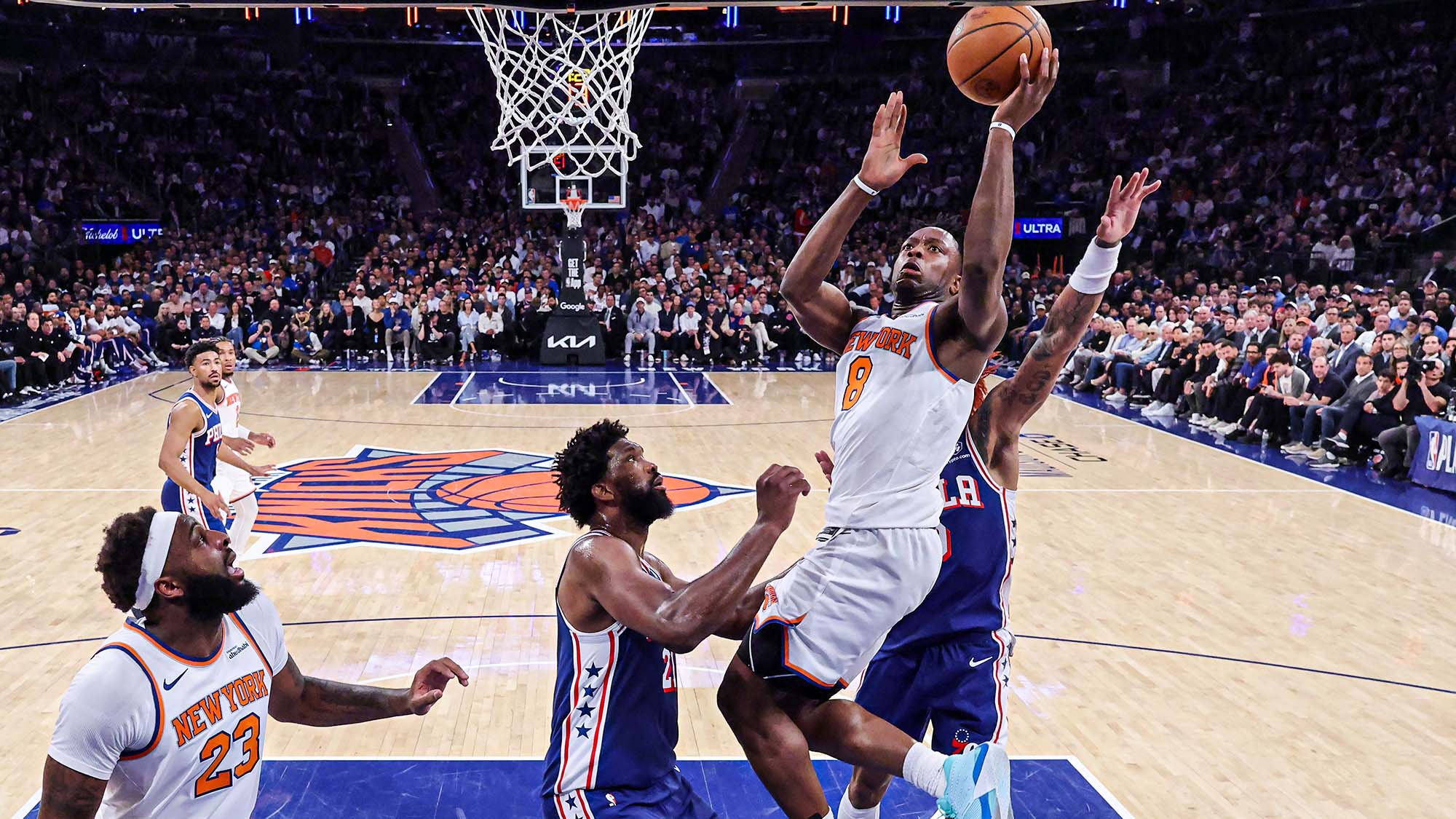
One win is one win, whether it’s by 51 points or a single point.
The New York Knicks learned that lesson against the Atlanta Hawks in the first round.
So did the Philadelphia 76ers, who lost by 32 points to the Boston Celtics in Game 1, only to go on to win the series, even after another 32-point loss in Game 5.
Nothing is decided between New York and Philadelphia after the Knicks’ dominant victory to open the Eastern Conference Semifinals. For all of the highlights New York racked up in the 39-point rout, Philly can steal control of the series with a measly one-point win in Game 2, just like the Hawks did in the first round.
With all of that being said, Philadelphia is already in dire straits. Game 1 revealed problems that the 76ers might not be able to scheme around, and one stat sums it up more than any other.
The 76ers’ fatal flaw
On Monday night, Joel Embiid was the screener defender against 27 on-ball screens. The Knicks’ offensive efficiency on those actions? A shocking 1.62 points per direct action.
If that number means little to you without context, just multiply it by 100 and visualize it as 162 points per 100 possessions (approximately the average number of possessions in an NBA game today).
According to the All NBA Podcast, that is the fifth-worst mark of Embiid’s career in games where he defended at least 25 on-ball screens.
At 32 years old, with a laundry list of injuries that would be long enough to cover all 72 stone steps leading up to the eastern entrance of the Philadelphia Museum of Art, Embiid is not the defensive enforcer he once was. He’s still got more than enough strength and skill to be a dominant force offensively, but defensively, he is sluggish and afraid of contact.
Embiid has not only dropped from elite status defensively, but he’s stooped all the way to traffic-cone levels.
There were warning signs of Embiid’s defensive fall-off in the regular season. The Sixers were just 1.8 points per 100 possessions better on defense with Embiid on the court than off, a 68th percentile ranking, which was a career-low for him.
That was still above-average, though, and when coupled with the 7.5-point boost he provided on offense, his overall on-off differential of 9.3 points was good enough for the 93rd percentile.
But after a grueling seven-game series against Boston in which Embiid took multiple blows that left him in obvious pain, he looked as slow-footed as ever in Game 1 against New York.
The Knicks, though, are equipped to exploit Embiid’s defensive drop-off in ways that the Celtics were not. Boston jacked up threes all series long, allowing Embiid to sit back and avoid dealing with contact (or the possibility of it). New York, however, aggressively attacked Embiid at the rim. More often than not, he was either too slow or too afraid of contact to provide any degree of resistance.
Embiid’s immobility on defense allowed New York to essentially score at will inside the arc. Through three quarters of Game 1 (pre-garbage time), the Knicks shot 73.9% from two-point range. As wild as that number is, the Knicks can sustain it from game to game if nothing changes about Embiid’s defensive activity.
Of course, New York’s 51.4% three-point shooting from Game 1 will not be sustained throughout the series. Three-point accuracy comes and goes, no matter how good the looks are. Boston learned this the hard way in Round 1. They had just as much of an opportunity to exploit Embiid as the Knicks, but they used it to generate threes instead of twos, leaving the door open for the advantage to be wasted by cold shooting, which is what happened.
The Knicks, though, are counting on the reliability of two-pointers to ensure they can keep their foot on the gas pedal against Philadelphia. They know that layups, dunks, and short mid-rangers for Jalen Brunson can be generated at will against Embiid, so they took advantage of it. This type of offense can be had anytime down the court, and the Knicks don’t have to be at the mercy of shooting variance for it to translate to the scoreboard.
So, what could the 76ers possibly do about this?
Not much, really.
Embiid isn’t getting any healthier at his age. He even seemed to get further banged up in Game 1, apparently aggravating his abdomen after taking an elbow to the midsection, nearly a month after he underwent surgery for appendicitis.
There won’t be any rest for the weary, either. After participating in the play-in and a seven-game first-round series, the Sixers are at a rest disadvantage against New York.
It’s also not as if the 76ers have a better option on their roster. Embiid’s direct backup is Andre Drummond, a 32-year-old, 279-pound rebounding specialist who is just as exploitable defensively as the worst version of Embiid.
Perhaps Embiid and Nick Nurse have a rabbit waiting to be pulled out of their hats. After all, this team just took down the 56-win Boston Celtics. Counting them out after such an impressive series victory would be foolish when the Knicks still have to beat them three more times.
But the 76ers have a problem that the Knicks are perfectly equipped to exploit, and there doesn’t appear to be an easy solution. That’s a terrifying sign as they attempt to avoid their sixth straight semifinals loss in the Embiid era.