
The 2026 NBA trade deadline brought good and bad news for New York Knicks fans.
The good news is that New York flipped struggling big man Guerschon Yabusele and two second-rounders into point guard Jose Alvarado and improved cap flexibility, by way of two trades with the Bulls and Pelicans.
The bad news? That would be the reason why Alvarado is coming to Madison Square Garden: To replace Miles McBride for the next two-plus months.
According to James Edwards III and Fred Katz of The Athletic, McBride is undergoing surgery for a core muscle injury and could be out until the playoffs.
That means Alvarado, the Brooklyn native, will immediately be thrust into a key role as one of the Knicks’ primary reserves.
Is the 27-year-old up to the task?
Based on the numbers, you bet.
He’s not quite McBride, but Alvarado is an exciting addition to the Knicks’ roster. He should have a role in the rotation once McBride returns to full health, and until then, he can be counted on to hold the fort down admirably.
Let’s dive into the strengths and weaknesses of Alvarado’s analytical profile. We’ll take at his role/usage, shooting tendencies, defense, on-off impact, and plenty more.
Role/Usage
Across five seasons with the New Orleans Pelicans, Alvarado has gained plenty of experience as a backup floor general.
For his career, Alvarado is averaging 20.3 minutes per game across 268 appearances (34 starts).
In 2025-26, Alvarado is averaging 21.9 minutes per game, coming off the bench in all 41 of his appearances.
An undersized player at 6-foot-0 and 179 pounds, Alvarado is a pure point guard. Per Basketball Reference, he has played 100% of his career minutes at the point guard position.
This is where Alvarado cannot be viewed as a one-for-one McBride replacement. McBride is capable of playing the 2 alongside a point guard, whether it’s Jalen Brunson or Tyler Kolek. In 2025-26, McBride has played 67% of his minutes as a shooting guard. That number was 81% in 2024-25.
It will be interesting to see how the Knicks fit Alvarado into the rotation alongside Brunson and Kolek. New York occasionally runs two-PG sets with Brunson and Kolek, so it’s not a foreign concept for them to use lineups that feature Alvarado alongside one of those two players, but they will miss McBride’s combo-guard skill set with Alvarado taking his minutes.
Excellent defensive track record
While losing McBride hurts, the good news is that the Knicks have landed a player they can trust to replicate McBride’s defensive impact in the backcourt.
Known as a pest who plays with the utmost intensity, Alvarado overcomes his small frame with nonstop energy, quick hands, and great instincts. He can be counted on to lock down opposing point guards.
According to Dunks And Threes, Alvarado owns a defensive EPM (estimated plus-minus) of +0.6, which ranks 46th in the NBA out of 226 guards, good enough to place him in the 80th percentile for the position. McBride is a +1.1, ranking 31st (87th percentile), so there shouldn’t be a significant drop-off on defense.
Among guards shorter than 6-foot-4, Alvarado is 16th in defensive EPM, just five spots behind McBride. It speaks to their reputations as two of the best defenders in the league against opposing point guards.
One of Alvarado’s greatest strengths is his ability to generate turnovers. For his career, he’s averaging 2.04 steals per 36 minutes, ranking 12th-best among players with at least 3,000 minutes over the last five seasons. In this area, Alvarado beats out McBride, who is at 1.42 for his career and 1.10 this season.
The uptick in steals will be welcomed in New York. The Knicks’ offense thrives on fastbreaks, ranking third-best in the NBA with 1.19 points per possession in transition, but they’re only 15th in transition possessions per game (21.1). That directly correlates with their No. 15 ranking in steals per 100 possessions (8.2).
Alvarado should generate a few extra fastbreak chances that the Knicks weren’t getting before, helping to create easy shots on offense.
As a one-on-one defender, Alvarado does a great job of forcing difficult shots, shown by the fact that he generally fares very well in NBA.com’s defensive tracking metrics. In each of the past three seasons (2022-23 through 2024-25), Alvarado held his matchups to a field goal percentage at least two points below their expected average.
In the 2024-25 season, Alvarado tied for 15th among guards (min. 50 games played) with an opponent field goal percentage differential of -2.0%, matching Jrue Holiday and one spot behind Derrick White. That’s the type of company you want to keep in defensive metrics.
So far in 2025-26, Alvarado has had a down year in this category, allowing a field goal percentage differential of 4.0%. The Knicks are hoping that it’s an outlier. Defensive field goal metrics can be wonky over smaller samples, but they tend to be accurate over multi-year samples, and Alvarado stands out as a significant plus when looking at his career body of work.
Consistent positive on-off impact
On the strength of his defense, Alvarado consistently makes his teams better when he’s on the court.
In all five of his NBA seasons, the Pelicans had a better net rating when Alvarado was on the court than when he was off. For his career, he has an on-off net rating differential of +5.4, per Basketball Reference.
Numbers like that are a positive sign for the impact of any NBA player, but it’s especially noteworthy when talking about someone who has played over 87% of his career games off the bench. Alvarado has spent most of his minutes with other bench players, and yet, the Pelicans were still significantly better when he played. This tells us that it’s pretty likely Alvarado is someone who makes his team better.
Seen below are Alvarado’s career on-off numbers, per Cleaning The Glass. Orange boxes indicate that Alvarado ranks higher in strengthening his team’s production in that category when he’s on the court; blue indicates that he ranks lower.
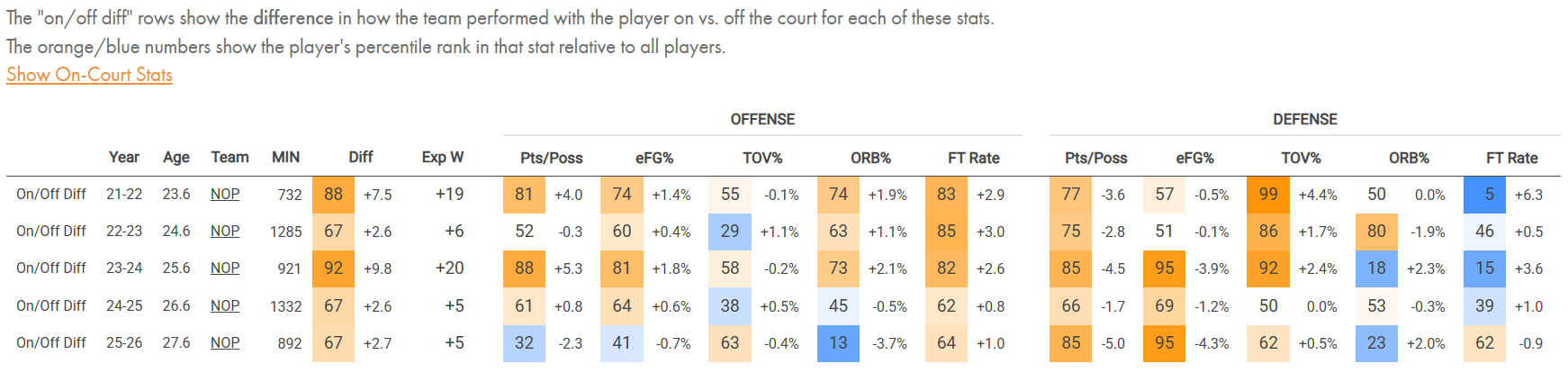
That’s a lot of orange.
The main thing that stands out is Alvarado’s consistent positive impact on defense. He still tends to have a positive impact on offense, but the numbers are less stable from season to season. Defensively, though, Alvarado always makes his presence felt. In five straight seasons, he has ranked at or above the 66th percentile in on-off defensive points per possession, with an average percentile ranking of 78th.
You can see that Alvarado does little to help his team’s defensive rebounding, and his presence actually tends to create more free throws for the opponent. However, he makes a tremendous impact when it comes to forcing turnovers and minimizing shooting efficiency.
It is encouraging, though, to see that Alvarado also typically has a positive impact on offense. If he were a 6-foot-0 point guard who could get some stops but played zero offense, he’d just be a short Frank Ntilikina. That’s not the case, though. Alvarado helps your offense, too, making him a well-rounded backup point guard.
Across his first four seasons, Alvarado had an average percentile ranking of 71st in on-off points per possession, which is quite good for a reserve player. The main source of his offensive impact is that he helps his team take more free throws. Interestingly, it is not thanks to Alvarado himself, as his free-throw rate is extremely low (1.9 FTA per 36 minutes in career). However, his passing helps create free throws for his teammates.
In Alvarado, the Knicks are getting a player who has consistently proven that his skills make a tangible difference on the scoreboard. There is substance to his fiery play.
Shooting profile
Alvarado is a willing shooter, taking 12.8 field goal attempts per 36 minutes in his career. This is similar to the career-high 13.3 mark that McBride has attempted in the current season, so Alvarado is capable of assuming the shots vacated by McBride.
He’ll launch plenty of outside shots, so the Knicks don’t have to worry about adding a non-shooter into their three-point-happy offensive scheme. For his career, Alvarado is averaging 7.8 three-point attempts per 36 minutes, about one fewer than McBride’s 8.9 this season.
Like McBride, Alvarado entered the league as a poor shooter and has gradually improved. After shooting 29.1% from three as a rookie, Alvarado improved to 33.6% in his second season and up again to 37.7% in his third, which remains his career-high. He’s at 36.3% this season on 4.7 attempts per game, and has shot 36.5% over the last three seasons.
Alvarado is nowhere close to the sharpshooter that McBride has developed into; Deuce is shooting 42% this year on 6.9 attempts per game. However, he’s still an above-average shooter on solid volume, which is a nice complement to his excellent defensive impact. The Knicks will happily sign up for that to help cover for the loss of a player as impactful as McBride.
Looking at Alvarado’s shot profile, I cannot help but smile as an analytics nerd. He has been completely allergic to long two-point shots this season, taking just 0.7% of his field goal attempts from 16 feet to the three-point line. Alvarado also rarely uses the middle of the floor, taking only 3.9% of his field goal attempts from 10-to-16 feet.
This season, Alvarado is taking a career-high 68.9% of his shots from deep. If he’s not shooting threes, he’s shooting near the basket, with 14.6% of his shots coming from floater range (3-to-10 feet) and 11.8% coming from within three feet of the basket.
Alvarado is having a career year when it comes to his finishing near the basket. He’s shooting a career-best 69.7% from within three feet, up from his career average of 62.7%, and his 43.9% shooting in the floater range is the second-best of his career, inching closer to the 45.9% league average.
Alvarado won’t be finishing in the paint like Jalen Brunson anytime soon, but it’s promising to see him adding a decent floater and good rim finishing to his offensive game. For a guy who has already developed an above-average three-point shot on solid volume, adding some buckets around the basket will only open up his outside game even more.
Thanks to his three-point volume and healthy shot profile from inside the arc, Alvarado has a career-high true shooting percentage of 55.8% this season. It’s still below the league average of 57.9% and comfortably behind McBride’s 59.2%, but the Knicks will take it for a player who is primarily out there for defense, hustle, and passing.
Passing
Alvarado isn’t an assist machine; his career average of 5.6 assists per 36 minutes is underwhelming for the point guard position.
However, Alvarado’s passing impact goes beyond his assist totals. He has developed into a poised floor general who knows how to make the right pass and facilitate ball movement, even if he isn’t the player who gets the assist credit.
Since the start of the 2024-25 season, the Pelicans have produced 3.1 more points off assists per 100 possessions with Alvarado on the court versus when he’s on the bench.
In particular, Alvarado helps create baskets inside the arc. Over the last two seasons, 63.1% of New Orleans’ non-putback two-pointers were assisted with Alvarado on the court, compared to 57.5% when he sat, a whopping 5.6% differential.
It speaks to Alvarado’s ability to help set up quality looks near the basket. Remember, when looking at his on-off data, the most palpable aspect of Alvarado’s impact on the Pelicans’ offense was the increase in free-throw attempts. We know that Alvarado was not taking those extra free-throw attempts, so it stands to reason that it was his passing that generated those extra chances from the stripe.
Alvarado is also good at protecting the basketball, averaging just 1.9 turnovers per 36 minutes in his career. That ability will fit snugly with a Knicks team that prioritizes protecting the basketball; New York has the fifth-lowest turnover rate this season (12.0%).
Rebounding/Miscellaneous
For a 6-foot-0 player, Alvarado’s career average of 4.1 rebounds per 36 minutes isn’t too shabby. He’s at a career-high 4.6 this season.
For perspective, Jalen Brunson is averaging 3.4 rebounds per 36 minutes this year. Even Mikal Bridges is only at 4.4.
McBride is at 3.3 this season, so Alvarado should be a slight upgrade in that department. It’s another category where Alvarado should fill up the box score a little more than McBride, along with assists and steals, although McBride turns the ball over less often (1.0 turnover per 36 this season), is a much better shooter, offers more positional versatility, and is an even better defender overall.
Overall takeaways
Alvarado projects as an excellent addition to the Knicks’ rotation.
First and foremost, what the numbers cannot measure is that Alvarado will bring a sense of nastiness that the Knicks, as well as they’ve played recently, did not really have in their lineup. They badly needed someone with an edge to help them grind out a seven-game series against a team like the Pistons. Alvarado’s intensity can be a spark plug in critical playoff moments.
Looking at his skill set, there are many ways in which Alvarado will help the Knicks. His shot-contesting and turnover creation will be welcomed on defense, which is the end of the court where the Knicks needed more help. Offensively, Alvarado’s high-volume three-point shooting on a good percentage will fit well into the team’s approach, while his steady passing will keep the ball moving when Jalen Brunson sits. His ball security fits into the Knicks’ emphasis on avoiding turnovers.
Overall, the most promising aspect of Alvarado’s profile is how consistently he made the Pelicans a better team. His on-off net rating was positive for five straight seasons, proving that the things he does well actually translate to the scoreboard, rather than just filling up the box score and highlight reels. He’s a legitimate difference-maker.
Obviously, due to the timing, Alvarado will inevitably be compared to McBride over the next few months. It’s understandable, but not entirely fair, as Alvarado and McBride are different players. McBride is also a younger player who has already ascended past Alvarado’s realistic NBA ceiling. So, fans should not expect Alvarado to replicate McBride, whether it’s from a skill-set standpoint or in terms of overall impact.
Still, the reality is that Alvarado will be tasked with filling in the backcourt minutes vacated by one of the Knicks’ most impactful players for the next two months. So, comparisons are going to happen.
On the defensive end, the Knicks can trust Alvarado to ensure there is little to no drop-off. McBride is arguably the better overall defender, as he is more switchable, but Alvarado’s elite turnover generation and excellent shot-contesting for the PG position will help him cover for the decreased positional versatility.
Offensively, Alvarado is not going to shoot anywhere close to as efficiently as McBride, and the Knicks will certainly miss McBride’s top-tier shooting. However, Alvarado can shoot at a similar volume while maintaining efficiency that is still quite solid, and he also offers passing ability that McBride does not.
Leon Rose and the Knicks hit a grand slam with their deadline-day maneuvering to land Alvarado. The timing of McBride’s injury makes the pickup all the more critical.
