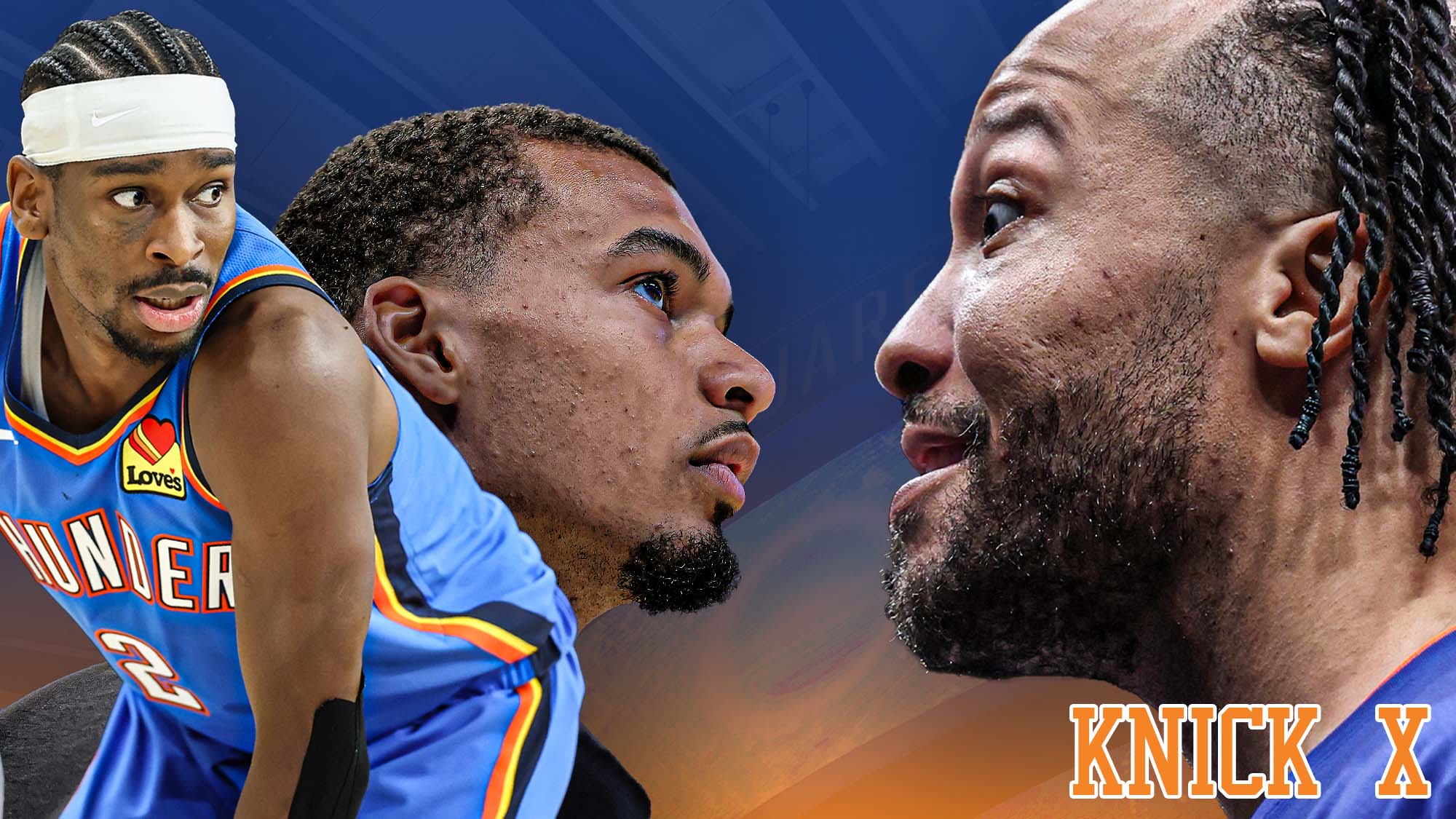
For the third time in a month, the New York Knicks calmly ended a playoff series while the other side of the bracket was still deeply entrenched in hardwood warfare, leaving New Yorkers with ample time to debate which opponent would be preferable for the orange-and-blue.
After the first round, Knicks fans debated 76ers-or-Celtics. Then, it was Cavaliers-or-Pistons.
In both scenarios, the Knicks ultimately swept their opponent in effortless fashion. That leaves us with one final debate: Spurs or Thunder?
For Knicks fans, this should be the easiest answer of the three…
It doesn’t matter.
Why it doesn’t matter who the Knicks face in the Finals
So much has changed over the course of the past month. To understand why the Spurs-or-Thunder debate has become meaningless, we have to relive the Knicks’ playoff journey step-by-step.
The Knicks had a tumultuous regular season, in which they constantly flip-flopped between an unstoppable juggernaut and a frustratingly mediocre team that seemed unable to maximize its talent. Entering the playoffs, it was far from a sure thing that they could be trusted to defeat any playoff opponent, so matchups felt critical at the time.
Going into the final day of the regular season, it seemed like the Knicks were on a crash course with the Toronto Raptors, a team they thoroughly dominated this year. Of all the Knicks’ possible matchups, Toronto felt like the best possible gift, and perhaps the only team that would be considered a “lock” for New York to beat.
But when the Atlanta Hawks surprisingly rested their starters for the regular season finale to draw the Knicks, the first round no longer felt like a surefire victory for New York. After the All-Star break, Atlanta had the best record in the East (20-6).
The Knicks were still the clear favorites, but there were plenty of NBA people who doubted that the Knicks would beat a red-hot Hawks team. Even a large chunk of Knicks fans thought the series would go six or seven games.
It ultimately took New York six games to beat a transitional Hawks team that didn’t appear to have playoff hopes before their post-All-Star surge. Sure, the losses were by one point, and the Knicks seemed to find answers over the final three wins, which were all by enormous margins… but six games are six games.
While the Knicks took care of business, they weren’t an established juggernaut just yet, which increased the sense of urgency for Knicks fans to hope that the team drew the ideal matchup between Boston and Philadelphia.
New York drew the lower-seeded 76ers. Many fans and analysts preferred this matchup, but there was a contingent of people who thought Boston was the better matchup. Regardless of who the Knicks drew, both sides were considered formidable veteran teams who would likely provide a tougher challenge than the young Hawks.
The Knicks wound up sweeping Philadelphia in a series that never felt remotely in doubt from the opening tip. As ugly as the 76ers looked during the matchup, they were still the same team that downed the second-seeded, 56-win Celtics, making it an impressive beatdown for New York.
By this point, the Knicks had won seven straight playoff games with a record-setting point differential over that span. Confidence was growing in the Knicks’ status as a reinvented machine that could no longer be stopped.
But it was obvious that Cleveland and Detroit were both far stronger teams than the aging, tired Philadelphia squad that New York had run circles around. Thus, it still felt important for the Knicks to draw the right matchup and maximize their odds of victory, even if Knicks fans had built the confidence that New York would have a great shot against either team—including a Pistons team that easily swept the Knicks in the regular season.
Fast forward to today. The Knicks utterly destroyed the same Cleveland team that took down the mighty, top-seeded Pistons. Not to mention, it’s also the same Cavaliers team that clobbered the Knicks in the teams’ lone regular season meeting after the James Harden trade.
As we sit here on May 27, the Knicks have won 11 straight playoff games. Their last defeat was on April 23; it was by one point, and the same goes for their only other playoff loss. The majority of the victories were by double-digits, including three road closeout wins by a combined 118 points.
Read that again. 118.
One-hundred and eighteen.
It would be wildly impressive if the Knicks had a +118 point differential through the entire playoffs to this point, let alone across three road closeout games against playoff-caliber opponents who were at the peak of their desperation. Throw in the rest of their games, and the numbers begin crossing into unfathomable territory.
The Knicks will enter the playoffs with a +271 point differential throughout the playoffs. That is the best mark in NBA history.
Yeah, the first digit there is a 2.
This is a one-month span of playoff games, people.
Here’s where you might close out the article in disbelief, thinking I inflated the numbers for shock value. Not only is the Knicks’ +271 point differential the best in NBA playoff history entering the Finals, but it is 75 points ahead of the previous record holder, the 2017 Golden State Warriors (+196).
Once again, I will ask you to re-read that number and take a second to process it: 75.
Seventy-five.
Has it sunk in yet what we are watching here? Not just the fact that it’s historic, but the degree to which it is historic?
Entering the Finals, the Knicks have been 75 points better than any playoff team in league history. It’s a margin so drastic that you probably ran a couple of Google searches to make sure I didn’t mistype it. But you can trust me—it’s completely legitimate.
Yes, the Knicks are playing the most dominant basketball in playoff history, and it isn’t even remotely close.
For that reason, the time to worry about matchups is in the past.
The Knicks have achieved basketball nirvana. Think of any all-time great championship team you have ever watched or heard stories about: none of them even sniffed the degree of destruction that the 2026 New York Knicks thundered down upon their conference opponents.
So, do your worst, Western Conference. Whether it’s a 7-foot-4 extraterrestrial or a back-to-back reigning MVP who can get to the foul line if you give him a dirty look, Jalen Brunson and the Knicks are ready.
Perhaps many would argue that the Spurs are a better matchup, given that the Knicks went 2-1 against them in the regular season and 0-2 against the Thunder. What we saw in games that go as far back as December is irrelevant at this point, though.
The only games that matter are those that have taken place from April 18 to now. And based on that sample, the Knicks are capable of beating any group of basketball players you could assemble. Grab a time machine, and that answer will be the same.
The 1996 Bulls? Nope, try again. They had a +157 point differential entering the NBA Finals, not even within 100 points of this Knicks team.
The 2000 Lakers? Try a +56 point differential on for size. You could give them two 100-0 victories, and they still wouldn’t match the Knicks’ +271.
Has the point been made yet?
Whether it’s San Antonio or Oklahoma City, the Western Conference champion will have to contend with the most dangerous team in playoff history—one so dangerous that even the most iconic champions of all time do not hold a candle to their dominance.
To choose a preference between San Antonio and Oklahoma City would be to disrespect the precise enormity of the gap that separates the 2026 Knicks from every other Finals participant that came before them.