
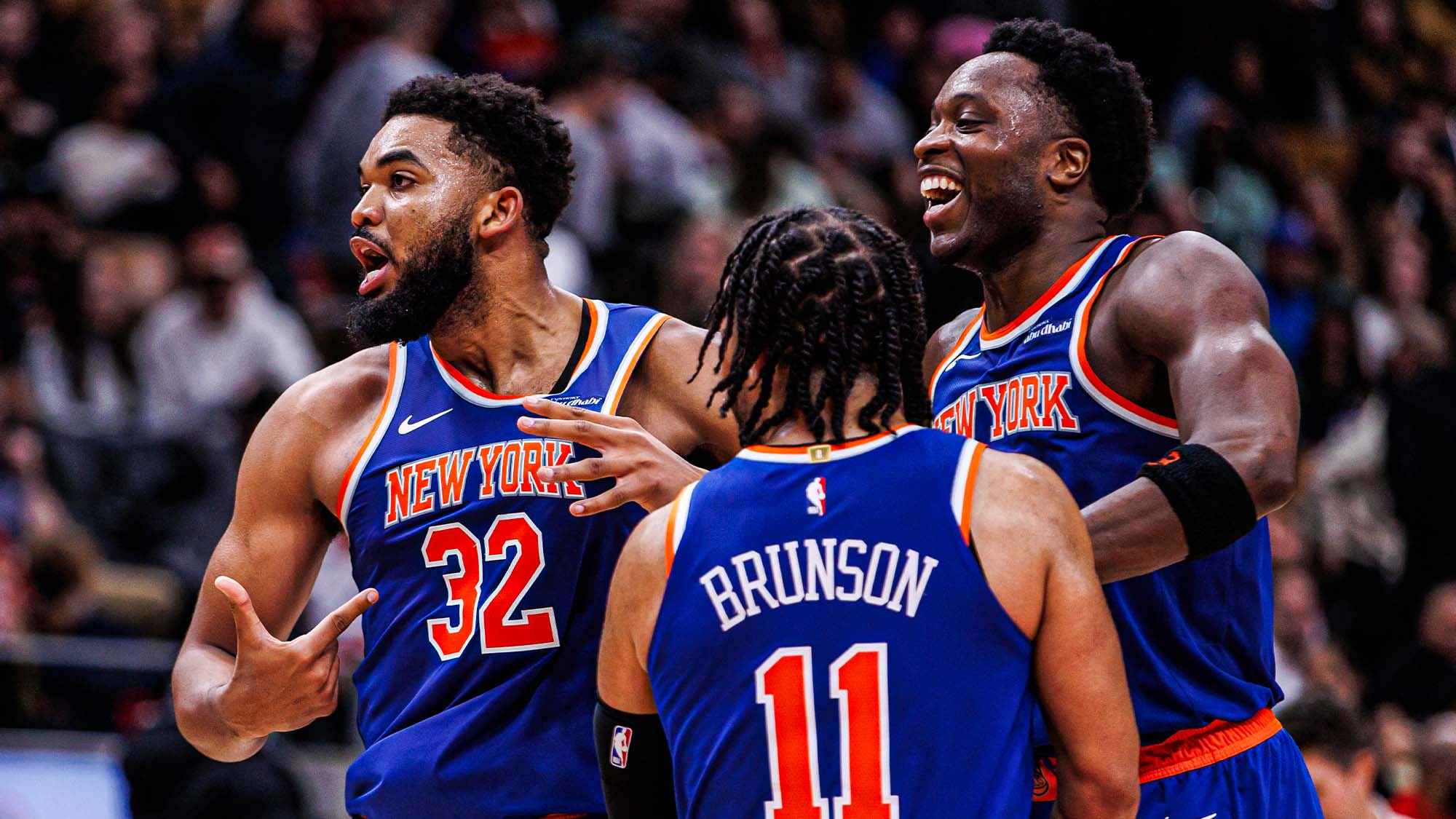
Elite basketball teams never rest on their laurels.
The New York Knicks have won six straight games, possess the Eastern Conference’s second seed, and are storming into Washington to take on a 13-35 Wizards team. Surely, this is a great night for the team to relax, right?
Wrong! If the goal is to win an NBA championship, that is.
The Knicks’ title hopes will not be made or broken by an early February game in the basketball mausoleum that is Capital One Arena (home to the 29th-ranked attendance per game this season)—although the building will experience its loudest game of the year tonight, thanks to the 90% portion of Knicks fans who will pack the house and dust off its cobwebs in the upper deck. If the Knicks lose, or even win in ugly fashion, it won’t change a whole lot about their odds of raising a banner in April.
However, these are the types of games where championship-caliber teams establish the type of consistency that is necessary to hoist Larry O’Brien trophies.
The Knicks still have plenty of ground to make up after their nightmarish post-NBA Cup stretch, which saw them field a 7-11 record and a 25th-ranked net rating (-5.0) over a month-long span from Dec. 18 to Jan. 19. That’s a large sample of basketball that was not even play-in-caliber, let alone championship-caliber.
A dominant six-game win streak, to the tune of a +24.3 net rating, has worked wonders to quickly restore the Knicks’ prospects as a legit title contender. Still, it’s only six games out of 82. New York has to keep building and building—possession, after possession, after possession, after possession—to truly establish themselves as one of the most consistent, reliable teams in the NBA, rather than just an erratic team with a high ceiling.
We know the Knicks have as high a ceiling as anyone. That much was obvious when they took down the mighty Boston Celtics in six games last season. What we’re trying to find out is whether they can be consistent enough to win four consecutive playoff series. That’s the mark of an elite NBA team, and it’s what they’ll need to rip through teams like the Detroit Pistons and the Oklahoma City Thunder deep into the spring.
A crushing win over Washington tonight, extending their winning streak to seven games, is the type of effort that can build further confidence in the Knicks’ ability to sustain elite-level consistency on a night-to-night basis.
Here are the Knicks’ keys to ensuring they take care of business in Washington.
1. Get to the foul line
The Wizards have been a semi-respectable basketball team for over a month now. They’re not quite as much of a cupcake as they were when the Knicks last saw them in early November.
Since a 3-20 start, the Wizards are 10-15. That includes a competent 7-7 home record. They’ve won three of their last four games coming into tonight, each of those at home, although all three wins were against sub-.500 teams, and the loss was a 31-point beatdown at the hands of the Lakers.
So, how have the lowly Wizards managed to play .500 basketball in their own building over the past month-plus?
Simple: Playing average defense.
Since Dec. 21, the Wizards have the NBA’s 14th-best defensive rating at home (113.4). It’s been enough for them to split their home games despite having the 29th-ranked offense at home (110.1).
It could be small-sample luck, but the basis of Washington’s decent home defense is their ability to guard the perimeter. Over their last 14 home games, they rank third-best in the NBA with a 32.4% three-point percentage allowed.
One area where the Wizards have still struggled, though, is sending opponents to the free-throw line. Even over this 14-game stretch of decent defense at home, they rank second-worst with 25.6 free-throw attempts per game allowed.
If the Wizards’ recent surge in solid perimeter defense is legitimate, it could be a semi-difficult night for the Knicks from the outside. However, free-throw attempts will still be readily available against a young, undisciplined Washington defense.
Collecting a bevy of free throws will help the Knicks stabilize their offense if the threes aren’t falling. It will allow New York to avoid the kind of cold streaks that could let Washington stick around, therefore maintaining constant pressure on the Wizards’ struggling offense to keep pace for four quarters.
2. Crash the offensive glass
When you face a bad team, your game plan must be to attack the problem areas that are most responsible for making them a bad team. Focus on exploiting the most vulnerable weakness, and everything else should figure itself out.
The Wizards are a horrendous defensive rebounding team. They rank 30th in the NBA with a defensive rebounding percentage of 70.7%, per Basketball Reference.
There is not a single player on the Wizards’ roster who is averaging more than 5.3 defensive rebounds per game. That smells like a major mismatch for the Knicks, who thrive on generating second chances.
Mitchell Robinson will rest tonight, as the Knicks are saving him for the Nuggets on Wednesday, so New York will be without their league-best offensive rebounder to exploit Washington’s embarrassing performance on the defensive glass. That means the rest of the team must pick up the slack with a heightened effort on the offensive boards.
As we discussed in the previous section, Washington has been quite solid lately at forcing misses from behind the arc in their own building, so there is a chance that the Knicks could stockpile bricks tonight. That only further emphasizes the importance of maximizing their mismatch on the offensive glass.
If the Knicks prioritize offensive rebounding and attacking the basket to draw fouls, it should be a successful night offensively, regardless of whether their outside shots are falling.
3. Take away the rim, encourage floaters
The Wizards struggle in most areas of offense, but one of their rare strengths is their ability to finish around the rim. They rank seventh-best in the NBA with a 72.4% field goal percentage within three feet of the hoop, per Basketball Reference.
Back them up a little bit, though, and the Wizards turn into brick masons. In the 3-to-10-foot range, the Wizards rank 29th in the NBA with an utterly ghastly shooting percentage of 39.8%. No NBA team experiences a greater drop-off in shooting efficiency from 0-to-3 feet to 3-to-10 feet (-32.6%).
The Knicks must build their game plan around these splits.
Generally speaking, NBA teams are always trying to force opponents into taking floaters instead of layups, as even the best floater-shooting team will not convert floaters as well as the worst rim-finishing team would convert layups. That’s just basic math and logic.
However, when facing an opponent like this, who is especially good at finishing around the rim and especially bad at making floaters, it becomes doubly important to build your defensive strategy around enticing the opponent to settle for two-point shots outside the restricted area.
What it comes down to is having the discipline to understand that it’s beneficial to allow an uncontested floater or short jumper. If the Knicks get into pick-and-roll situations, the roll defender must aggressively drop down and defend the roll to the basket, practically begging the ball handler to jack up a shot. It’s the type of defense that might look bad to the casual observer, as the Knicks are allowing an uncontested shot, but the logic makes sense. Willingly giving up a 39.8% shot is a win.
Washington has a pair of dangerous rollers in Alex Sarr and Marvin Bagley. Per NBA.com, Sarr ranks third-best in the NBA (min. 20 GP) with 4.3 points per game as a roll man, while Bagley is 15th with 2.6 points per game. Sarr has a 56.6% effective field goal percentage as a roll man, while Bagley is a sparkling 76.0%.
Whether it’s Karl-Anthony Towns or someone else, the roll defender’s priority is to drop deep and eliminate a rim attempt for Sarr or Bagley. Let the ball handler shoot, because whoever it is, he’s more likely to brick the ball than score it.
There isn’t a single player on the Wizards’ roster who shoots 50% from the field as a pick-and-roll ball handler. Their leader in P&R ball-handler possessions per game, Kyshawn George (5.0 possessions per game), shoots 44.8%, alongside a brutal 20.1% turnover rate. Their second-most common P&5 ball-handler, Bub Carrington (4.0 possessions per game), shoots 39.8% with a 21.3% turnover rate.
Playing smarter, not harder, is the Knicks’ key to keeping the Wizards quiet. Just take away the one thing they do well, finishing at the rim, and let their young shooters build houses from floater range.
Modern NBA defense is more about wits than grit. The game moves too fast (and the rules are too anti-contact) to win with physicality. Defenses can’t take away everything the way they once could.
Playing the percentages is the key to defensive dominance. You have to understand your opponent’s strengths and weaknesses, eliminate what they do best, and force them into doing what they’re worst at. From there, the ball should bounce your way over 48 minutes.
Tonight yields an opportunity for the Knicks to show that they can continue mastering the art of modern NBA defense. They’ve been great at it in recent games, and they will have to keep it up if they want to beat teams like the Nuggets, Pistons, and Celtics over the upcoming week.
Obviously, Washington is not nearly as threatening as those teams, but the same logic applies to stopping the Wizards as stopping any other team: scout the strengths and weaknesses, eliminate the strengths, and live with them taking their worst shots.
Let’s see if the Knicks’ coaches and players can continue building on their collective ability to form and execute a smart, cohesive game plan. Mikal Bridges said it best, telling SNY after the win over Los Angeles, “Effort can (only) do so much without having a plan. I think just having a plan and knowing what we’re all doing with the effort has made a difference.”
