

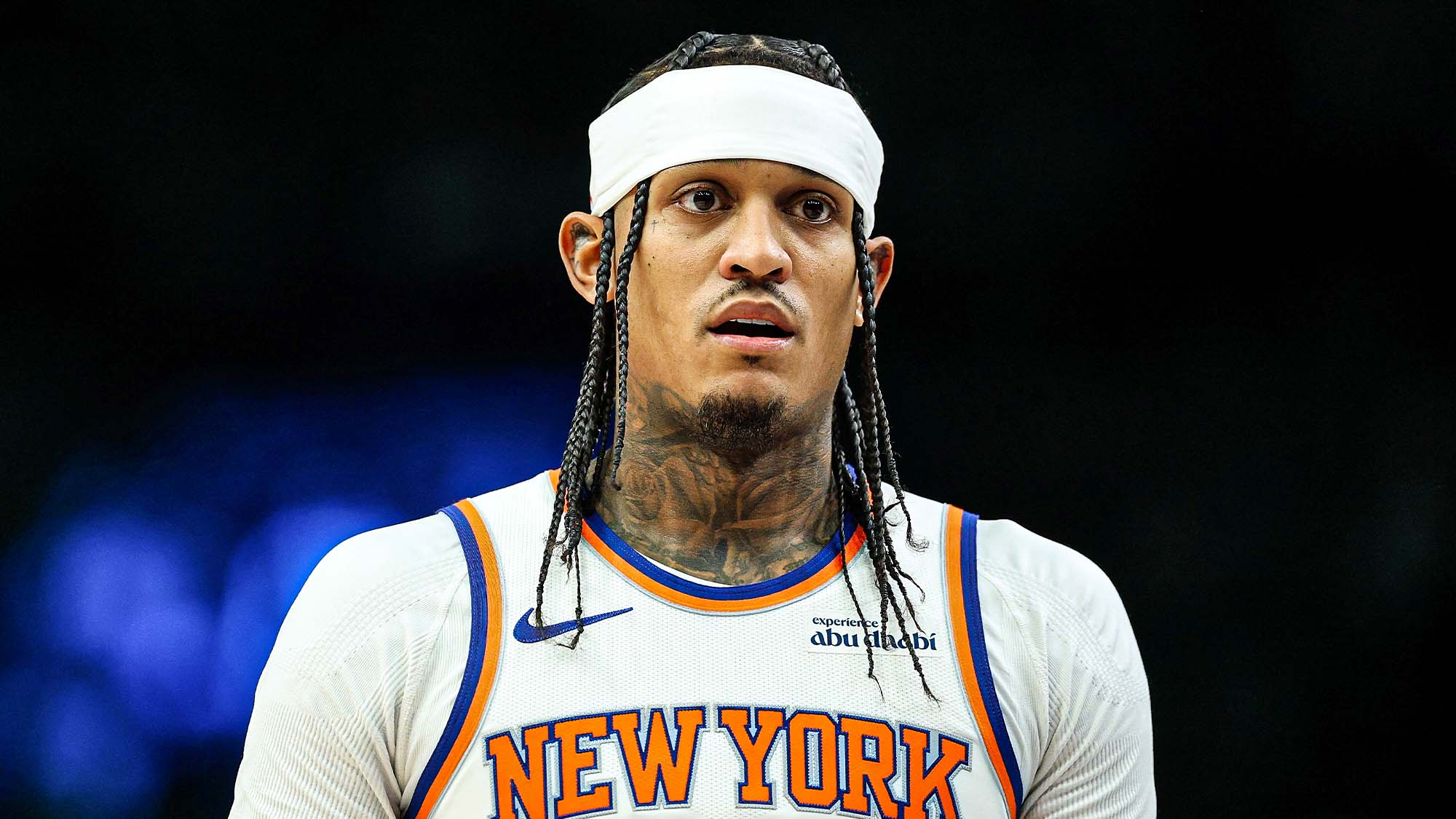
Fresh off perhaps their most embarrassing loss of the decade, the New York Knicks turned around and delivered the most merciless beatdown in the franchise’s 80-year history.
Basketball is weird like that.
In New York’s 120-66 win (no, that is not a typo) over the Brooklyn Nets, one of the noticeable changes made by head coach Mike Brown was the removal of Jordan Clarkson from the rotation. The veteran microwave, who ranks seventh on the team in total minutes this season (859), did not check in until the start of the fourth quarter, when New York was already up by 32.
It goes without saying that the move worked, at least for one game. Without Clarkson, the Knicks jumped out to an 88-56 lead going into the final period. Clarkson’s exit paved the way for a huge performance from Landry Shamet, who scored 18 points in 15 minutes on 6 of 7 shooting from downtown.
Wednesday marked just the 19th appearance of the season for Shamet, who missed 25 games with a shoulder injury. Before heading to the sidelines, Shamet was above Clarkson on the Knicks’ depth chart. Across his last six games before the injury, Shamet was averaging 28.0 minutes per game to Clarkson’s 20.8. Shamet had even started three games in place of the injured OG Anunoby in the Knicks’ starting lineup.
Thus, with Shamet back on the court, it is not surprising that Clarkson’s role has dwindled. Still, Clarkson retained a key role in the rotation when Shamet was healthy earlier in the year. Brown’s recent decision to bench Clarkson is a new development.
The blowout over Brooklyn was the first Knicks game all season in which we did not see Clarkson over the first three quarters. However, Brown kick-started a soft benching for Clarkson in the previous game, a horrific loss to Dallas. Clarkson played the final 1:42 of the first quarter and never appeared again.
It seems clear that the demotion of Clarkson is a deliberate button that has been pressed by the Knicks’ maligned head coach, who is searching for answers as his team struggles to play to its full potential.
Is it a smart move that could pay dividends over the long run? Or is Brown just throwing stuff at the wall until something sticks?
Examining the decision to bench Jordan Clarkson
Based on how the Knicks have played with Clarkson on the court this season, there is a good chance that removing him from the rotation will pay dividends.
According to Basketball Reference, the Knicks are outscoring their opponents by 1.4 points per 100 possessions with Clarkson on the court, compared to 6.7 with him off. That -5.3 differential ranks second-worst among the 12 Knicks players who have logged at least 200 minutes, ahead of only Guerschon Yabusele (-6.3).
What makes those numbers especially daunting for Clarkson is that he spends a large chunk of his minutes alongside the Knicks’ most impactful on-off player, Miles McBride.
McBride’s +11.4 on-off differential (+11.4 with McBride on, 0.0 with him off) is the best on the Knicks by a wide margin. Clarkson has played 322 of his 859 minutes with McBride (37%).
When McBride shares the court with Clarkson, the Knicks are able to ride McBride to success despite Clarkson’s shortcomings. New York is a +5.3 per 100 possessions with those two players on the court.
However, when Clarkson is on the court without McBride, his negative impact is exposed. In 537 minutes with Clarkson on the court and McBride on the bench, the Knicks are a -1.3.
Meanwhile, McBride’s minutes without Clarkson show how much Clarkson is holding back McBride. In 603 minutes with McBride on the court and Clarkson on the bench, the Knicks are an otherworldly +13.9. That is slightly better than the Oklahoma City Thunder’s net rating this season (+13.4), and it’s a sample size worth the equivalent of more than 12 whole games.
Connect the dots, and it’s clear who the weak link in the Knicks’ second-unit backcourt is:
- Knicks with McBride on, Clarkson off: +13.9
- Knicks with McBride and Clarkson on: +5.3
- Knicks with McBride off, Clarkson on: -1.3
Clarkson has a negative impact on almost every teammate that he plays with. Of the Knicks’ 34 two-man combinations that have logged at least 200 minutes, eight of the 11 worst (in terms of net rating) feature Clarkson.
It isn’t difficult to understand why Clarkson has such a negative impact on the Knicks’ success. Defensively, he’s a sieve, and offensively, all he’s really good at is taking a bunch of shots. Occasionally, he hits a few of them in a row, and it gets fans on their feet. More often, though, he leaves points on the court.
Clarkson has a true shooting percentage of 53.1, which is third-worst among the Knicks’ top 12 players in minutes, ahead of only Tyler Kolek and Yabusele. However, Clarkson shoots far more often than either of those players, which means his inefficient shooting is much more detrimental to the team.
Based on his true shooting percentage, Clarkson has cost the Knicks 39.4 points compared to average, the worst mark on the team. In other words, on his volume of field goal attempts and free throw attempts, he has scored 39.4 fewer points than he would have scored with a league-average true shooting percentage.
Clarkson’s ability to score in bunches is usually credited as the primary appeal of his game, but the reality is that it only makes him even more detrimental to the team because of his inefficiency. If you shoot less efficiently than the average NBA player, taking a high volume of shots is a bad thing. It means you are generating bad possessions at a high rate.
A Knicks possession that ends in a Clarkson shot is a victory for the defense. Almost any other player shooting the ball would be preferable. So, the more he shoots, the more points the Knicks leave on the floor. And he shoots a lot; his 15.4 field goal attempts per 36 minutes are third on the team behind only Karl-Anthony Towns (16.3) and Jalen Brunson (21.9).
Letting a guy with a 53.1 true shooting percentage jack up shots at the third-highest rate on your team is a great way to shoot yourself in the foot.
Removing him from the rotation, though, is an excellent path to immediate improvement, especially when the replacement is a guy like Landry Shamet.
Shamet has a 65.6 true shooting percentage this season. Every Clarkson shot that is transferred to Shamet is a massive boost for the Knicks’ offense.
Shamet won’t replicate Clarkson’s shot volume, but the rest of Clarkson’s inefficient chucks can go to someone like Miles McBride, who is not taking nearly enough shots relative to his efficiency. Think about this: Clarkson, a 53.1% true shooter, is taking 2.2 more field goal attempts per 36 minutes than McBride (13.2), a 60.6% true shooter.
The math isn’t mathing.
At least, it wasn’t, until Brown made the correct call to get Clarkson and his heat-checking bricks off the floor.
Benching Clarkson isn’t a cure-all for the Knicks, but it’s an easy call that should immediately make the Knicks a few points better each night.