

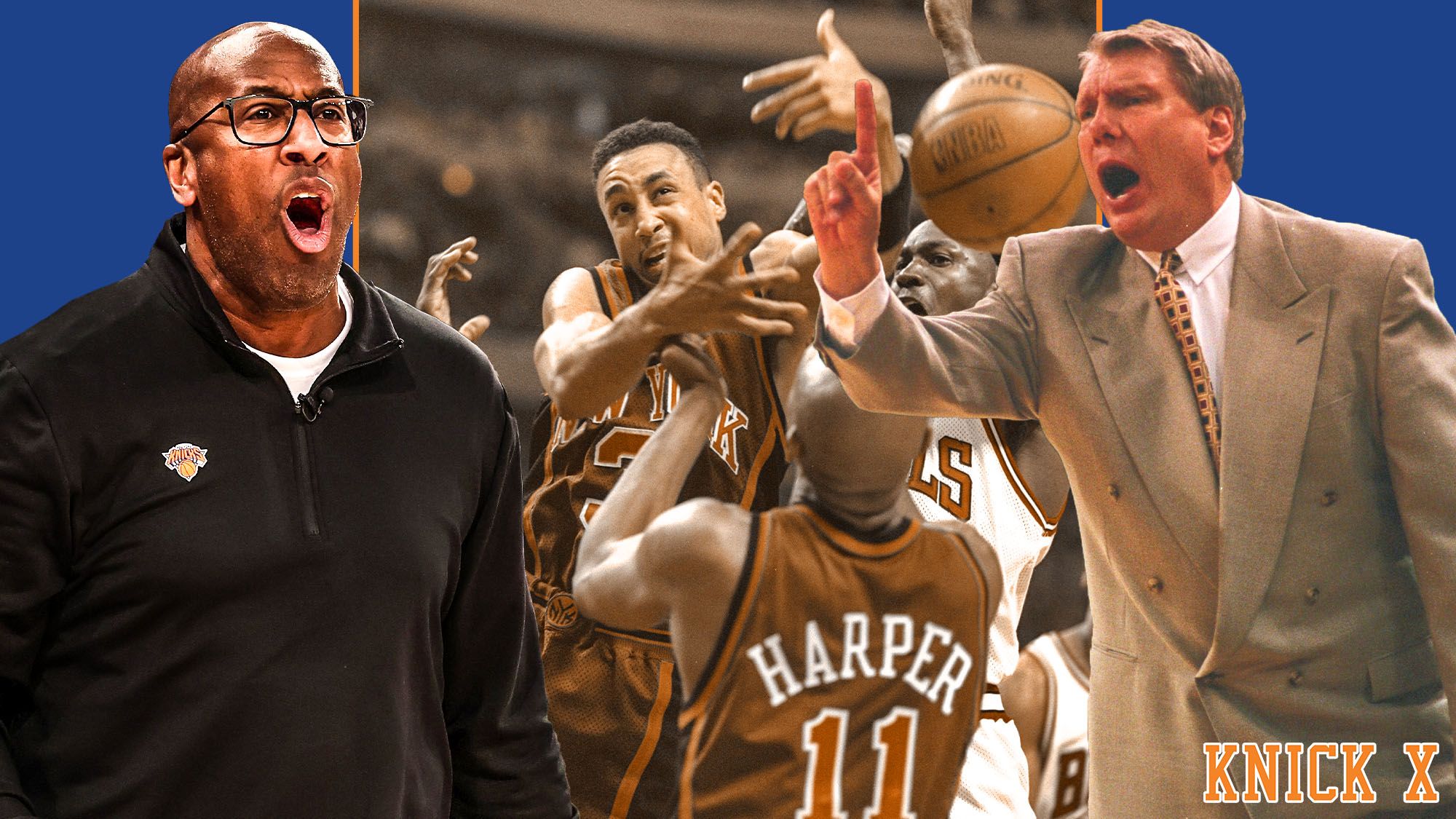
Let’s at least face the reality of the situation at the top: This season’s version of the New York Knicks is more inconsistent than the previous iteration.
It makes perfect sense. In replacing Tom Thibodeau, head coach Mike Brown embraced the “collaboration” themed changeover, a move since confirmed by Knicks executive chairman James Dolan on WFAN.
Collaboration or not, Knicks fans have clearly seen the intent of change. More offensive movement, an increased shuffling of the roster’s deck, and abundant three-point shooting (sheer volume) — much of which is celebrated in popular Knicks’ social media circles.
While the big city geeked itself during the NBA cup run, things have since settled down a bit. Scratch that; things have deteriorated to the point that Karl-Anthony Towns has become the next public enemy No. 1.
Hopefully, for the Knicks fans’ sake, Thursday night in Sacramento against the Kings produces the squad’s second straight victory — after a rough stretch that saw them lose six of the previous eight games.
Why is it happening, though?
It has to be inconsistency, along with a lack of baseline identity that fits the personnel.
Hoisting up more threes makes sense in today’s NBA, where threes are all the rage. Yet, on a purely logical scale, despite the increase in percentage in recent basketball times, threes remain the lowest-percentage shot in the Association.
New York’s 39.9 three-point attempts per game have it ranked tied for seventh in the Association (with a third-ranked 37.8 3P%). This contrasts sharply with the Knicks’ 34.1 three-point attempts per game last season, which ranked 27th.
Yet last year’s 36.9 3P% — while closely resembling this year’s number — is still below this year’s mark. Therefore, logically speaking, it had to be the right move to shift to a more three-point-dominant squad, right? Not only are they taking more threes in a three-point-driven league, but they’re making more threes.
Well, there’s a funny thing about that thought. More on that later.
Living and dying by the three makes it incredibly difficult to remain as consistent as previous teams, particularly when previous Knicks squads were firm in understanding their own identity.
For those old enough to remember, this particular coaching change bears a striking resemblance to one of Knickerbockers’ yesteryear.
Right man, wrong coach
It’s impossible to remember who uttered the quote in real time, but shortly after the Knicks fired Don Nelson in March of 1996, somebody uttered the perfect quote to explain the situation…
“Don Nelson was the right man but the wrong coach for the job.”
Perhaps it was MSG Network’s Al Trautwig, who regularly did the pregame in those days. Maybe it was somebody else altogether; it doesn’t really matter.
The point of the paraphrased quote above holds water today: Don Nelson, as great as his basketball mind has always been, did not fit with that tough-and-tumble Knicks team.
Nelson was an offensive guy, first and foremost, and his famed “Nellie Ball” was scooped up by then-general manager Ernie Grunfeld and the powers that be, in an effort to remake the Pat Riley squad — the very same squad who gave the prime Bad Boy Detroit Pistons a run for their money in the physicality department, while replacing them as Michael Jordan’s greatest threat in the east.
Remarkably, New York shot out of the gate quickly that season. Nelson’s transformed squad won 10 of its first 12 games, which had Knicks fans hyped beyond belief. (Remember, this marked the season after Patrick Ewing’s infamous fingerroll miss against the Indiana Pacers, as well as Riley’s infuriating faxed resignation.)
To say Knicks fans were aching for a championship at this time — just a year and a half removed from NBA finals heartbreak in Houston — would be a massive understatement.
Either way, the Nelson experiment failed pretty spectacularly. His 34-25 record with the Knicks that year — before being replaced by assistant coach Jeff Van Gundy in March — doesn’t look disastrous on the surface. But for those who actually experienced the Nelson stint live, what played out in front of our eyes was as ill-fitting as anything in Knicks land.
The evolving landscape
Although these changes couldn’t hold a candle to the offensive nonsense we experience today, David Stern’s NBA did its damnedest to increase offense.
Starting with the 1994-95 season, the NBA moved the three-point line closer to the rim. There was also a strong emphasis on perimeter hand-checking and low-post changes, aimed at increasing scoring.
Therefore, New York brought the offensive-minded and uptempo Nelson on board after he had been sitting on his couch since resigning as the head coach of the Golden State Warriors in February 1995.
While sure, it’s true: Nelson’s uptempo game changed the identity of those Patrick Ewing teams out of the gate, for my fellow old heads who remember that season, something just felt … off.
Ewing didn’t look right, Charles Oakley couldn’t quite find his place within the offense, and the Knicks guards, who previously did tremendous things within Riley’s intent-driven half-court, low-box offense, couldn’t quite find their legs, as they looked to push the pace at every turn.
Then, much like now, rather than ripping apart players like KAT (who absolutely deserves the criticism; make no mistake about that), they should ask themselves this tough-to-face question…
Are the New York Knicks trying to play a modern brand of ball for the sake of fitting in, or do they truly believe it suits this roster?
Is Mike Brown the next Don Nelson?
The two most noticeable changes on the stat page center around an uptick in three-point volume and a notable decrease in defensive metrics.
On the one hand, this Knicks collaboration seems to fit where the NBA is and where it continues to go. On the other hand, these drastic changes in team identity clash with the personnel.
When Jalen Brunson, Karl-Anthony Towns, and Mitchell Robinson are on the floor together, the Knicks are anything but an athletic and speedy squad. There’s just no two ways around it. (When Mitch is off the floor, there is a whole set of other issues which we won’t even get to on this day.)
Worse yet, we knew this last season, when Thibodeau’s defensive creativity and late-game defensive substitutions were as transparent as anything in the game.
Even with Mitch on the bench, KAT, coupled with Brunson, makes for an impossible defensive situation. Yet, it also doesn’t allow New York to compete with the uber-athletic teams in the NBA (see how the Indiana Pacers ran Thibodeau’s Knicks out of the gym in last year’s Eastern Conference Finals).
For Thibs, it was simple: There’s no reason to speed up the game when our roster is best suited to play more deliberately. As much as the Garden faithful despise Brunson’s “iso ball,” there was always a method behind that madness.
A faster pace is not this Knicks roster’s friend, and shooting more threes doesn’t help slow down the pace. Although New York’s 99.29 pace-of-play number is just 23rd in the league — somewhat resembling last year’s 97.64 (26th ranking) number — the effort and intent clash with everything at the heart of his roster, particularly the captain.
It works for the defending champion Oklahoma City Thunder, whose ultra-athletic roster traits feed into it. Imagine a world where Shai Gilgeous-Alexander and Jalen Brunson swapped teams. Would OKC continue to play the way they do now? No chance.
Brunson is a drastically different type of player from the man the kids call SGA.
For better or worse, Brown has led the Knicks to a volume three-point shooting identity. When the shots are falling, everything is great. When they don’t, however, things look as bleak as the Isiah Thomas days. (Ok, I went way too far there, so scratch that one.)
Where’s the ace in the hole?
Nonetheless, the idea hits home. Inconsistencies are plaguing the Knicks, and they seemingly can’t be solved by their defense, evidenced by their steadily dropping 115.7 defensive rating this season.
Not only does pushing the pace and chucking up threes with a slower-footed team come at a major cost on the defensive end, but the unsolvable problem of KAT plus Brunson on the defensive end of the floor — which was easily spotted last year — persists.
At the very least, an NBA team relying on three-point volume must have a few aces in the hole. The closest the Knicks have to that is their fourth-ranked offensive rebounding prowess.
Unfortunately, aside from Josh Hart’s contribution, that ace in the hole is largely dependent upon the oft-injured Mitchell Robinson. Insanely, last year’s team only had the 7-footer for 17 regular-season games.
Still, even with the offensive rebound advantage, what else can these Knicks cling to? What do they do so well? What can they rely upon as this season gets into the nitty-gritty, other than making shots from distance?
Don Nelson finished his Knicks career with a 34-25 (.576) mark before being replaced by assistant coach Jeff Van Gundy. Mike Brown’s rookie Knicks coaching effort has produced a 25-15 (.625) mark. Interestingly, it’s just a half-game better than where Nelson was to start his infamous Knicks stretch, at 24-15 (.615).
Hey, there isn’t one basketball fan who can ignore this sport’s evolution. This is especially the case for the kids who grew up on Pat Riley’s 1990s squads.
It’s those very same old heads, however, who can spot when something is intentionally force-fed down the throats of a roster that is not capable of swallowing.
For the New York Knicks fans who have dreams of “championship-contender status,” there’s only one hope: Mike Brown’s squad gets hot at the right time and never misses from distance. They’ll need to go on a near-mythical run that has the NBA Jam announcer losing his bananas-driven mind.
There’s just no other way because the baseline consistency and lunch-pail effort we saw in previous years has vanished into thin air.
When the Knicks shoot the lights out, they win. When the Knicks shoot poorly, they lose, and no championship-contending team can live that way. There must be baseline consistencies that a team’s identity can rely on, night in … and night out.